
This emerging research theme develops a flexible taxonomy for organising the many forms of segregation identified across the literature. Rather than treating segregation as a single phenomenon or arranging its variants within a fixed hierarchy, the approach classifies segregation forms through a set of higher-order facets: their nature, the social groups involved, the main mechanisms through which separation occurs, its spatial or institutional extent, and the degree of choice, constraint or coercion involved. This allows different forms of segregation to be compared without reducing them to a single dimension, such as residential location or ethnic separation.
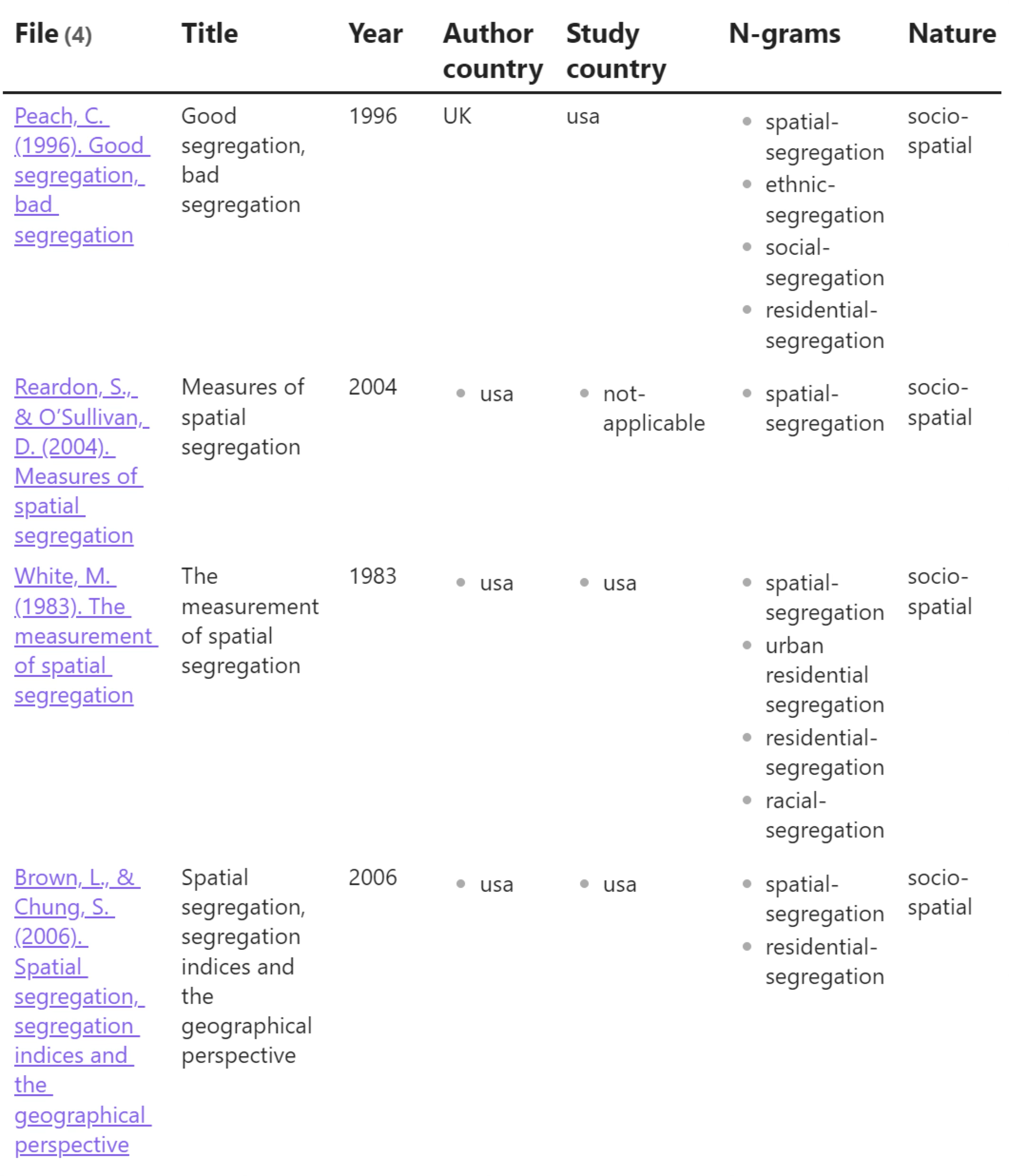
Classifying segregation forms in the literature: example of a faceted table linking key publications, extracted segregation terms and conceptual attributes such as nature, social groups, mechanisms, study context and spatial extent. The table supports systematic comparison across works.
The faceted taxonomy is designed as an interpretive and exploratory framework. It helps reveal how different concepts of segregation cut across domains, scales, behaviours, territories and disciplinary traditions. For example, a form such as residential segregation may be connected to race, ethnicity, income or age; it may operate at the neighbourhood, city or metropolitan scale; and it may involve both voluntary and involuntary mechanisms. By combining facets, the framework makes it possible to locate specific forms of segregation within a broader conceptual space, trace their relations to key works in the literature, and support the development of Segregation Wiki as a searchable, relational knowledge platform.
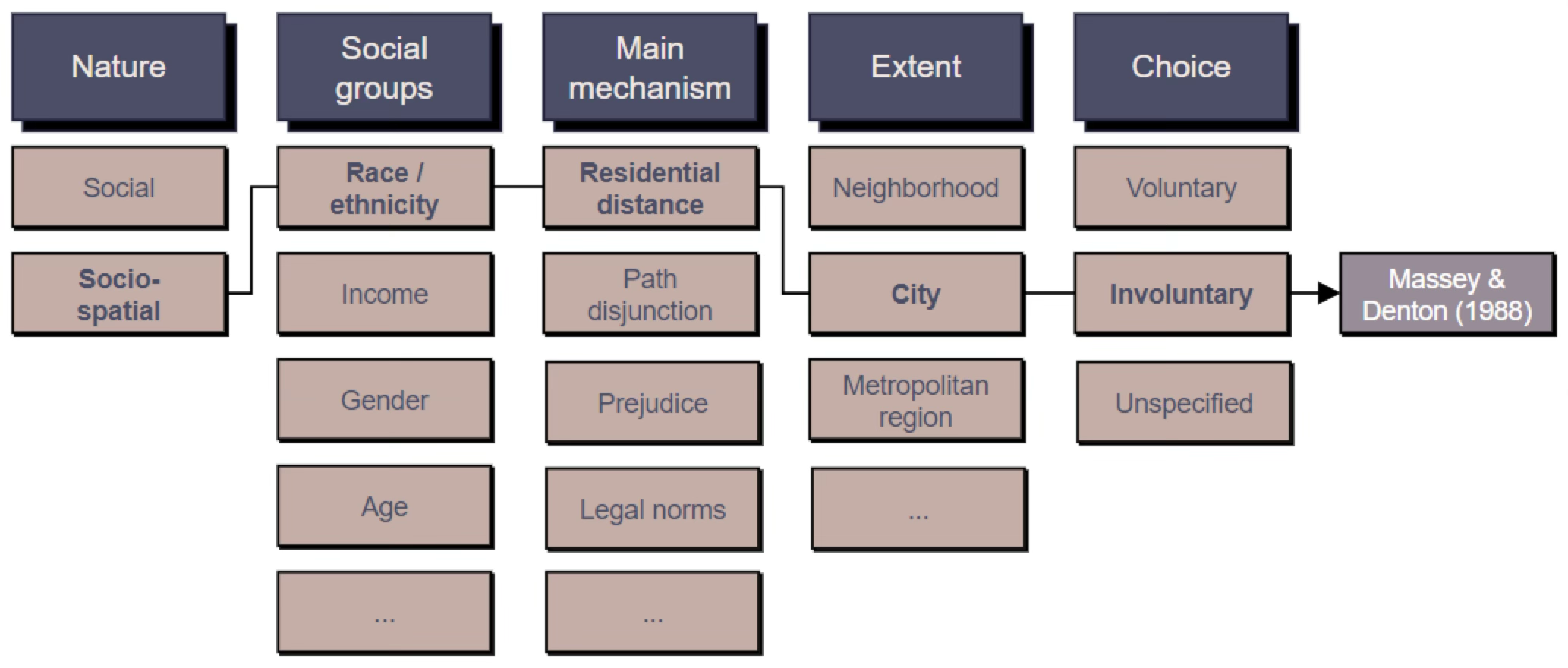
A faceted taxonomy of segregation: conceptual framework for classifying segregation forms according to their nature, social groups, main mechanisms, spatial extent and degree of choice or constraint. The diagram illustrates how specific forms of segregation can be positioned across multiple facets rather than reduced to a single hierarchical category.