
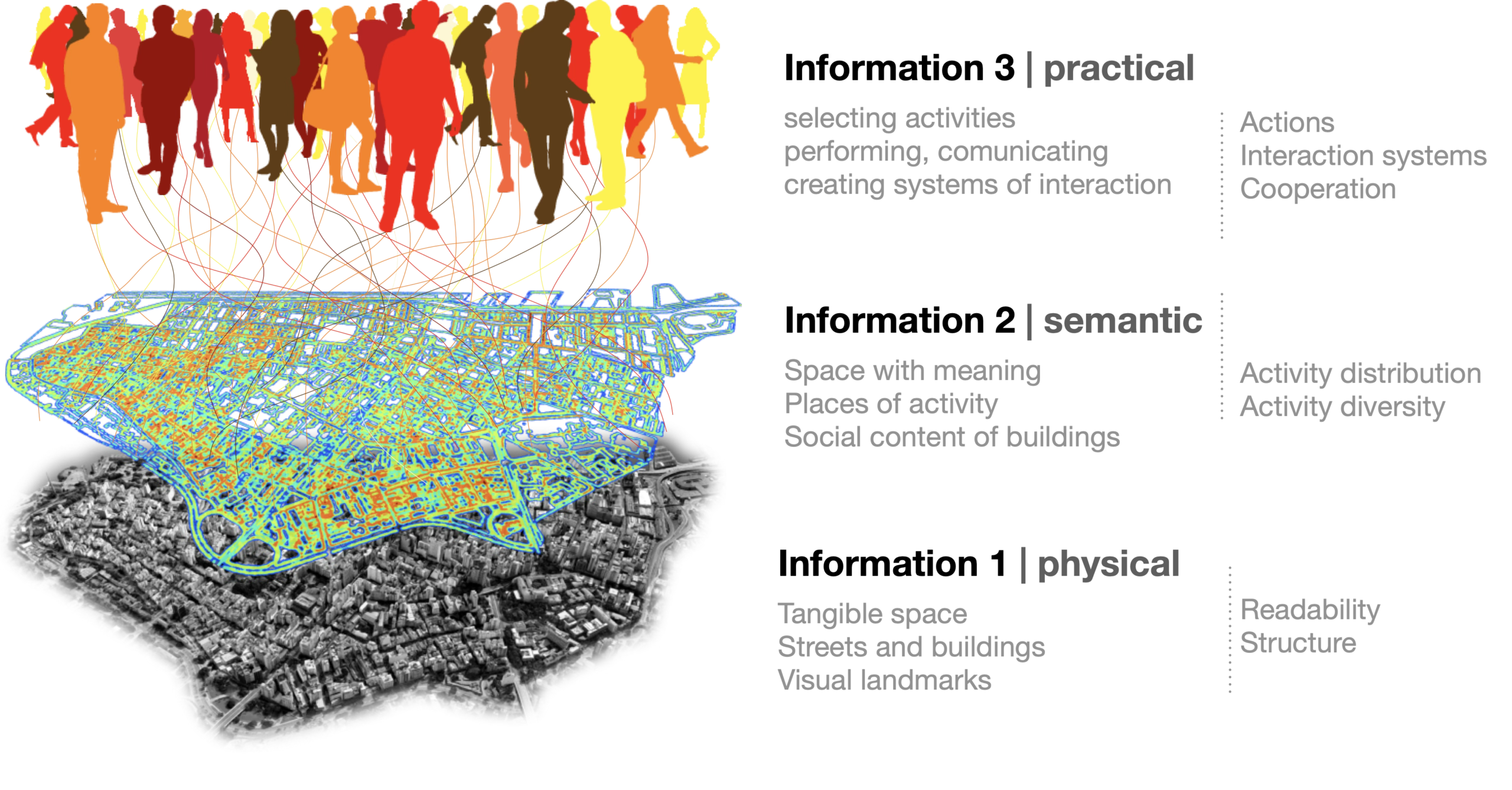
This theme examines cities as structures that help societies cope with uncertainty, disorder, and the fragility of coordination of collective action. It explores entropy both as a conceptual problem and as an empirical tool for understanding urban form, information, interaction, and sustainability. On the one hand, cities create material and semantic structures that reduce uncertainty in collective life; on the other, they generate metabolic and environmental pressures that must also be managed.
The Information Continuum
How cities encode social life – from physical space to lived experience
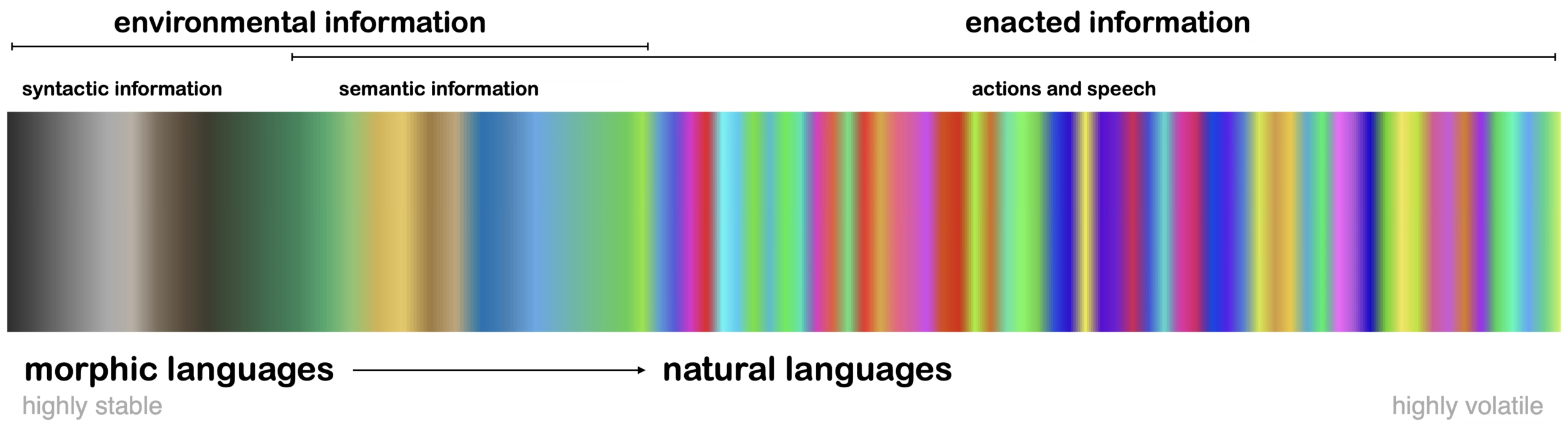
Visual metaphor of the information spectrum: from highly stable and little diversified to highly volatile and diversified forms of information in the sociospatial realm. Colours represent different information contents.
Netto has been developing a concept of “information continuum” running from the most stable and physical forms of social information, such as built form and spatial configuration, to more volatile and diverse forms, such as activities, encounters, speech, and communication. Society can be understood as a material system of interactions, in which agents communicate and exchange information through actions mediated by architectural and urban space. Starting from Bill Hillier’s Space Syntax, built space already contains a form of social information: its configurations, sequences, partitions, openings, and topological relations encode constraints and possibilities for encounter. However, this syntactic information is only one part of a wider spectrum. Urban environments also contain practical and semantic information: land uses, activities, practices, signs, routines, and meanings enacted by people in places. The key move is to treat these not as separate ontological domains – physical space on one side, meaning on the other – but as different manifestations of information across different media and degrees of stability.
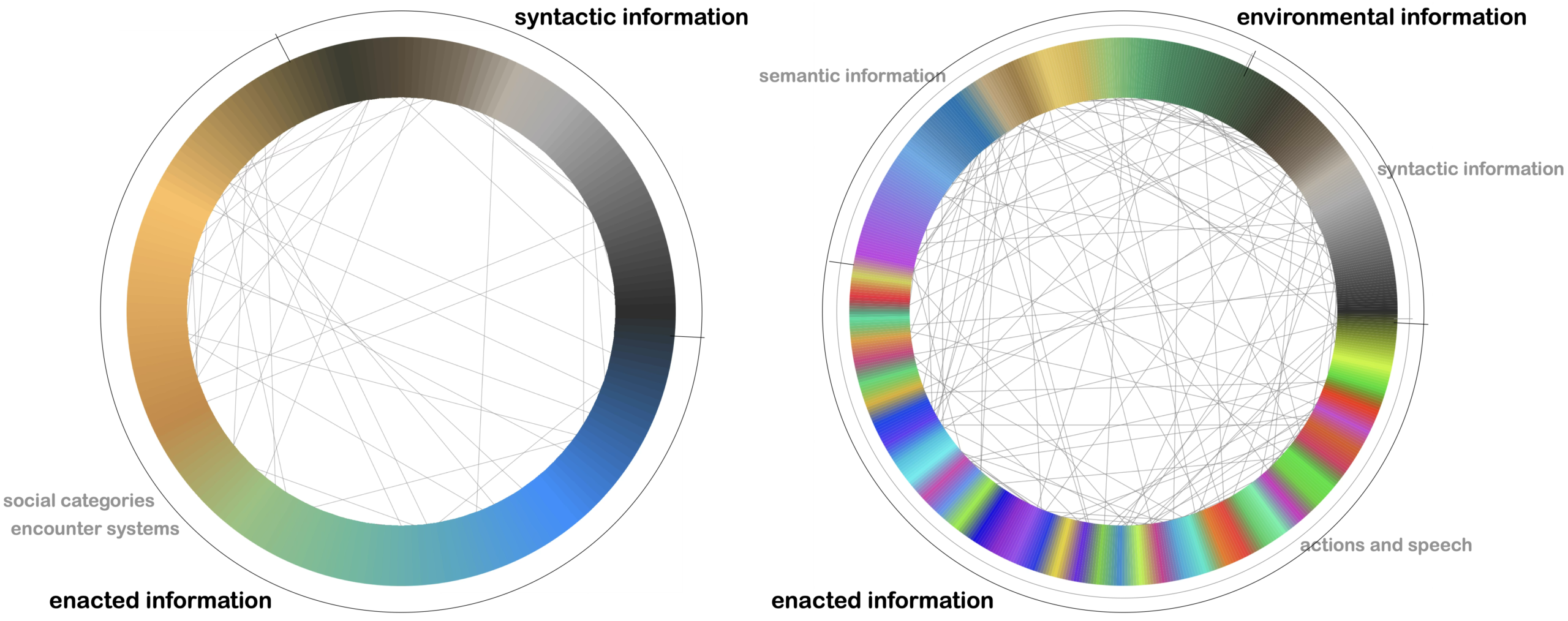
Visual metaphor of two takes on sociospatial reality: from social information in the Space Syntax object domain (left) to social information in an expanded consideration of environmental information and action systems (right). The former helps to structure the latter, while the latter contains the former. Edges link colours, and colours represent units of information expressed in spaces, social categories, encounter distributions, differentiated actions, and communication contents uttered in interactions. Only 20% of possible edges between randomly selected colour units are represented in both diagrams.
In this framework, physical space becomes the starting point for a broader sociospatial theory: syntactic information structures patterns of encounter, but social life also depends on the combinatorial explosion of information produced in practices and communicative exchanges. By reframing the relation between matter and meaning as a continuum of information, the proposition seeks to overcome the divide between physical space and semantic content, and to open a path toward a more rigorous theory of how societies use urban space to organise interaction, cooperation, and social reproduction.
Cities as cooperation systems
Our approach to cities as cooperation systems argues that cities are not merely containers of social life, but informational environments that make cooperation possible in complex societies. Built form, spatial configuration, accessibility patterns, land uses and activity places preserve and organise environmental information, helping people infer where to go, what to expect, whom they may encounter, and how to coordinate actions with others. The city therefore acts as a material and semantic medium for reducing uncertainty: it transforms the immense combinatorial field of possible actions into more probable encounters, sequences and forms of interaction. In this sense, urban space helps convert social entropy into structured complexity. Cooperation emerges not only through explicit communication, institutions or norms, but also through the everyday use of spatial and semantic information encoded in the built environment.
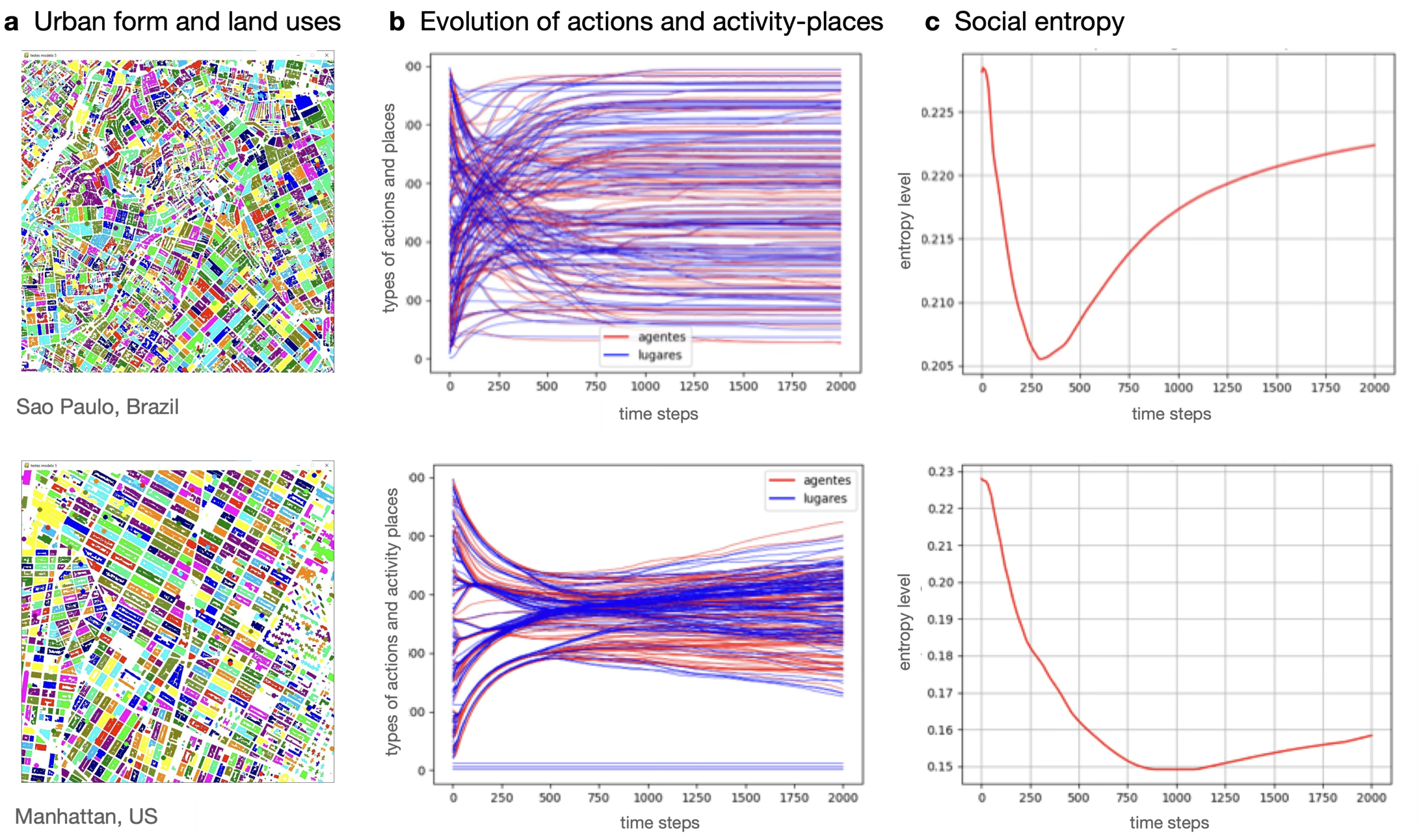
Preliminary results from the CUE — Cooperation in Urban Environments — agent-based model: (a) two cities with different levels of spatial organisation and fictitious land-use distributions generate (b) different trajectories of convergence in action and activity-places types and (c) distinct entropy dynamics.
Ordered spatial structures and diverse land-use patterns affect coordination in interaction systems, while agent-based simulations suggest that proximity, activity places and environmental information increase the alignment of actions among agents. Cities thus become cooperation platforms: durable environments through which societies store, retrieve and enact information, enabling interactions to cohere into larger systems of collective life.
Publications
Netto, V. (2007). Practice, Communication and Space: A reflection on the materiality of social structures. Doctoral thesis, University College London (UCL). https://discovery.ucl.ac.uk/id/eprint/5060/
Netto, V. (2008). Practice, space, and the duality of meaning. Environment and Planning D: Society and Space, 26(2), 359-379. https://doi.org/10.1068/d0406
Netto, V. M., Brigatti, E., Meirelles, J., Ribeiro, F. L., Pace, B., Cacholas, C., & Sanches, P. (2018). Cities, from Information to Interaction. Entropy, 20(11), 834. https://doi.org/10.3390/e20110834
Netto, V. M. (2025, August 9). The information continuum: How cities encode social life – from physical space to lived experience. Substack. https://viniciusmnetto.substack.com/p/the-information-continuum