
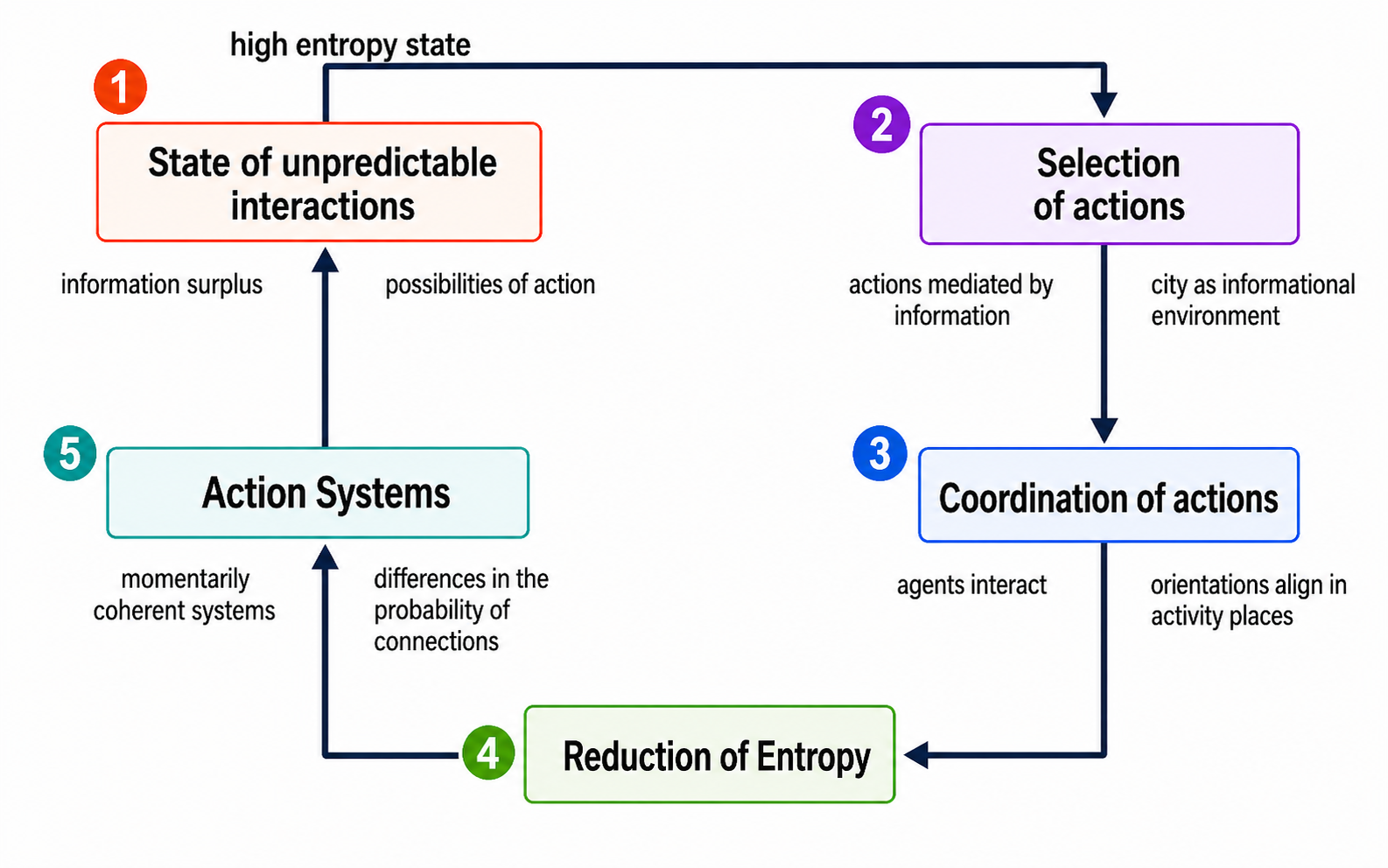
The cycle of social entropy: from (1) the high unpredictability of potential actions to (2) the selection of actions mediated by spatial information, to (3-5) a momentarily ordered system, as actions converge into places, only to dive in entropy again. This recursive process conducts interaction systems from chaotic states (high social entropy) into coherence (low social entropy).
This research examines cities as open, self-organising systems that persist by continuously managing entropy – the tendencies toward uncertainty, disorder, degradation, and fragmentation affecting both urban form and social life. From this perspective, entropy becomes a problem of self-maintenance: cities enable societies to reduce the entropy of action by coordinating movement, encounter, exchange, and cooperation across dense networks of agents and places. They emerge as organised configurations within a vast space of possibilities, reducing internal disorder through processes such as morphogenesis, spatial differentiation, functional specialisation, infrastructure provision, repair, adaptation, and collective learning. At the same time, they remain dependent on flows of energy, matter and information from their environments, generating externalities such as waste, pollution and resource depletion. Understanding cities through entropy therefore helps clarify both their extraordinary capacity for self-maintenance and their vulnerability to ecological and systemic limits. This work brings together Netto’s approaches – linking urban morphogenesis and structuration with an understanding of cities as systems of information and cooperation.
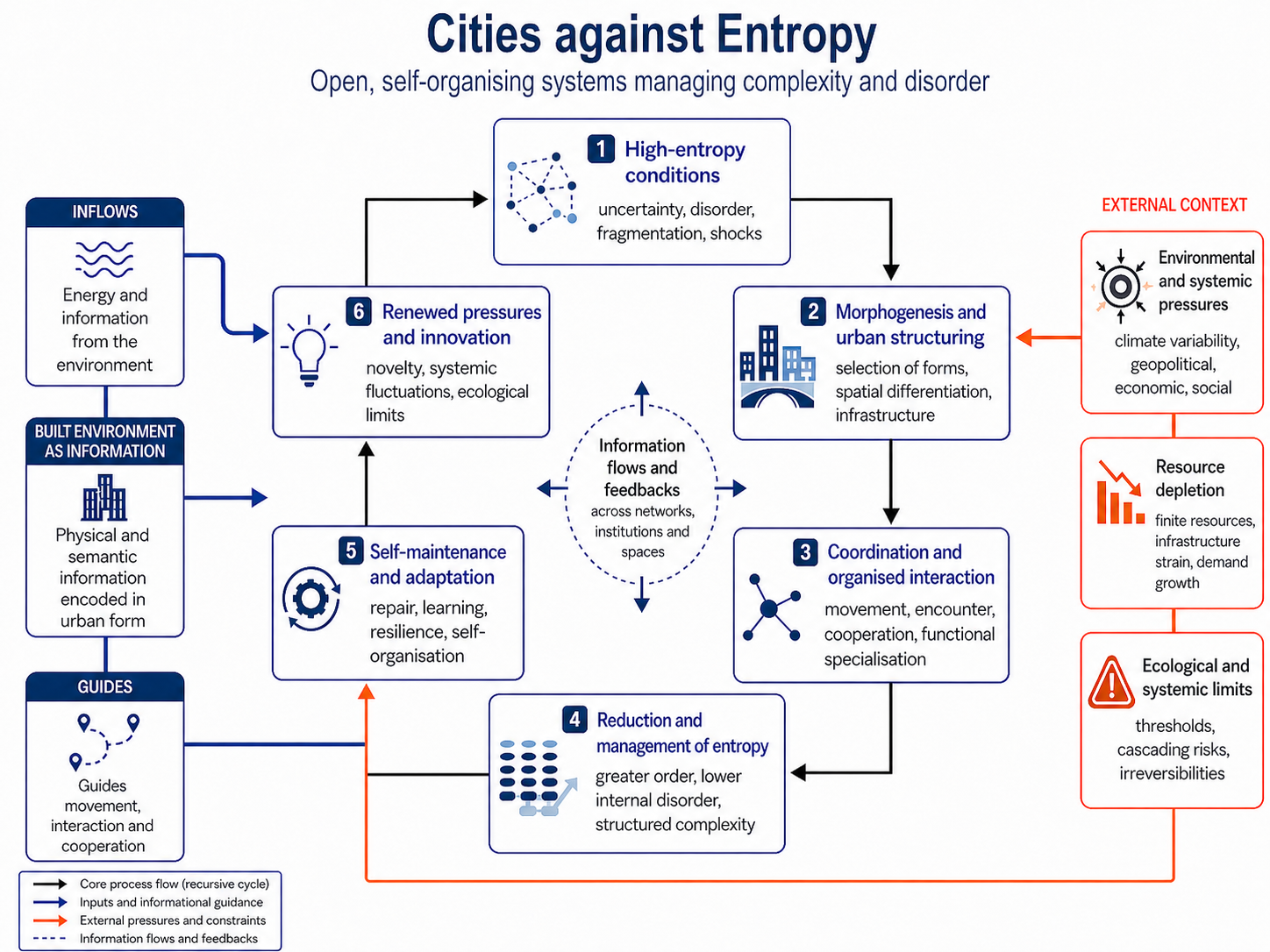
Cities as systems that manage uncertainty, disorder and systemic pressures through morphogenesis, spatial differentiation, informational guidance, coordination, adaptation and self-maintenance. The diagram shows how urban structures transform high-entropy conditions into organised interaction, while remaining dependent on inflows of energy, matter and information and vulnerable to external fluctuations and environmental limits.
The work also argues that entropy is not simply the opposite of sustainability. Urban life depends on fluctuations, novelty, serendipity and innovation — all of which introduce new possibilities and degrees of uncertainty into social systems. Cities become crucial because they help societies absorb, organise and transform this uncertainty. Through physical and semantic structures, built environments encode information that guides movement, interaction and cooperation; through adaptation and self-repair, they respond to shocks and improve over time. In this sense, cities are not only sources of environmental entropy, but also collective mechanisms for managing complexity: they help transform disorder into structured interaction, enabling societies to endure, adapt and reproduce themselves.
Publications
Netto, V.M., Peres, O.M., Cacholas, C. (2025). Entropy and the City: Origins, Trajectories and Explorations of the Concept in Urban Science. In: Rybski, D. (eds) Compendium of Urban Complexity. Understanding Complex Systems. Springer, Cham. https://doi.org/10.1007/978-3-031-82666-5_12
Netto, V.M., Meirelles, J., Ribeiro, F.L. (2020) Cities and entropy: assessing urban sustainability as a problem of coordination. In Binder, C.; Wyss, R.; Massaro, E. (Eds) Sustainability Assessment of Urban Systems. Cambridge: Cambridge University Press, pp. 438-459. https://bit.ly/36GauLY
Netto, V. M., Meirelles, J., & Ribeiro, F. L. (2017). Social interaction and the city: The effect of space on the reduction of entropy. Complexity, 2017(1), 6182503. https://doi.org/10.1155/2017/6182503