
This research programme explores cities as material solutions to complex social organisation. It asks whether urban form encodes spatial cultures, how the first cities emerged across different regions, and why cities occupy a distinctive place among human settlements. Using information theory, archaeology, morphogenesis, and morphospace, it examines how buildings cluster into blocks, streets, and larger structures, and how these forms reflect planning cultures and historical paths. Its central argument is that cities resolve a density–mobility paradox: growing division of labour requires proximity and density, but density obstructs movement. Cities succeed by combining density, permeability, and structure across scales into forms that sustain cooperation:
- Morphogenesis: Structure-seeking growth
- Cities in morphospace
- Spatial cultures: Urban form as information
Morphogenesis: Structure-seeking growth
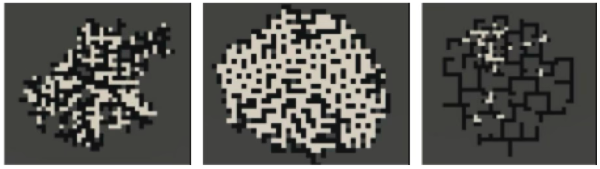
Simulating the emergence of urban structures across scales: typical preliminary outputs of the Morphogenesis cellular model obtained by varying parameters (Netto et al., 2025c).
Cities emerged independently in different regions of the world, yet they developed recurring spatial features alongside enormous formal diversity. This work investigates how that happened, asking what social and spatial conditions made urban formation possible across regions and historical periods. It approaches urban morphogenesis as a process of structure-seeking growth, in which increasingly complex societies generated spatial innovations to support proximity, interaction, movement and coordination. Drawing on theories of urban form, biological notions of morphospace, and archaeological evidence, the research traces how simple built elements evolved into more complex arrangements — from cellular units to blocks, street networks and larger spatial structures — as settlements learned to balance density, permeability, visibility and organisation across scales.
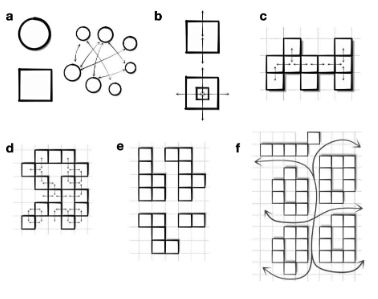
Spatial innovations in urban morphogenesis: (a) Archetypal circular vs. square cells – circular units allow only proximity clustering. (b) Innovation of square cells enables face-to-face growth. (d) Corner attachment impedes a coherent open-space system. (e) Face aggregation resolves that problem. (f) Successive bending of linear aggregates produces ring micro-structures and opens the possibility of global order (Netto, 2017).
Human settlements in Morphospace
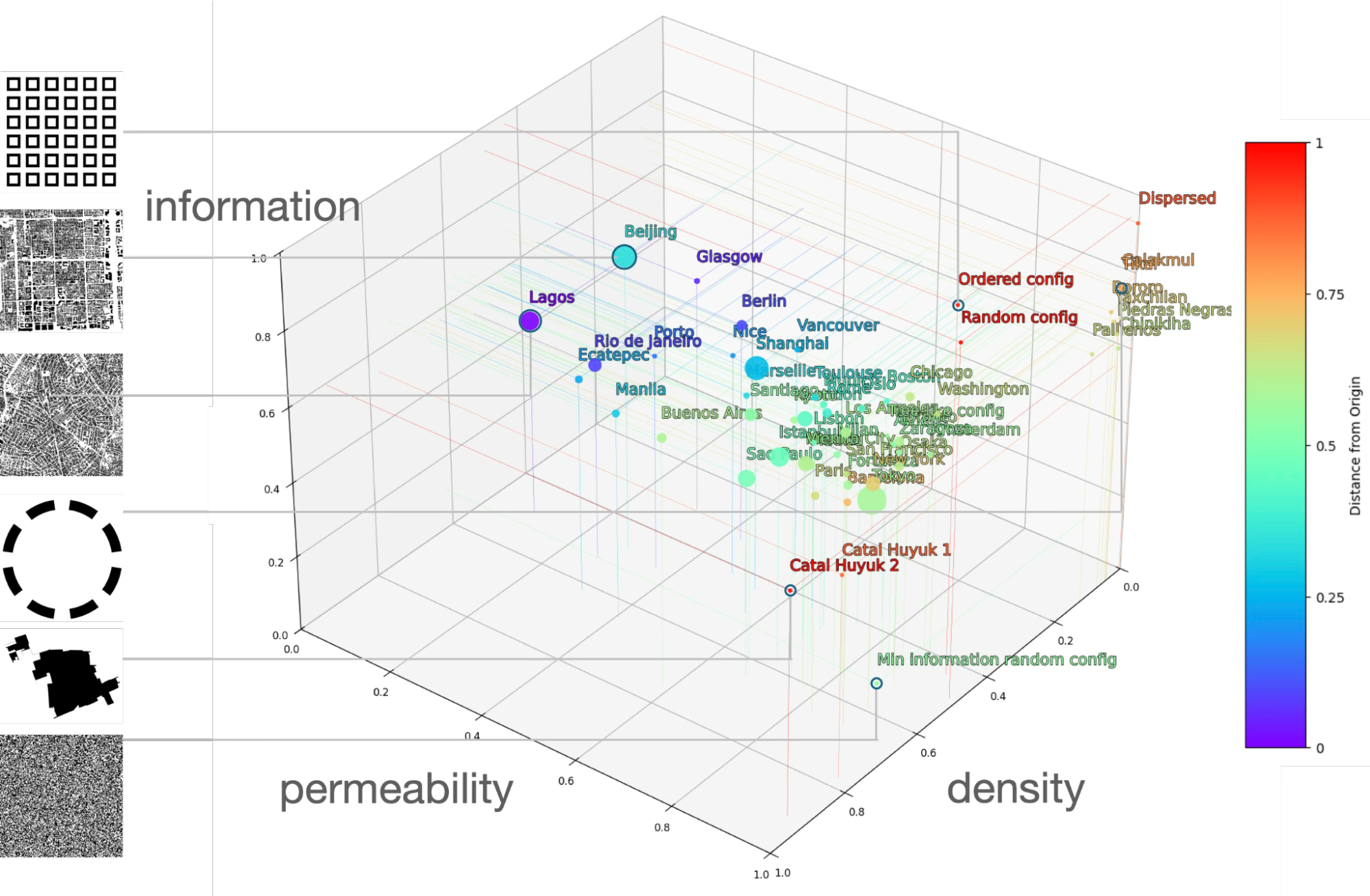
A morphospace for urban and non-urban settlements: The cube illustrates the positions of configurations according to information, permeability and density signatures. Colours show intensities found by our method in cellular configurations of built form, from blue (low) to red (high). Dot sizes represent population sizes for all settlements derived from census data and archaeological estimations (Netto et al., 2025a).
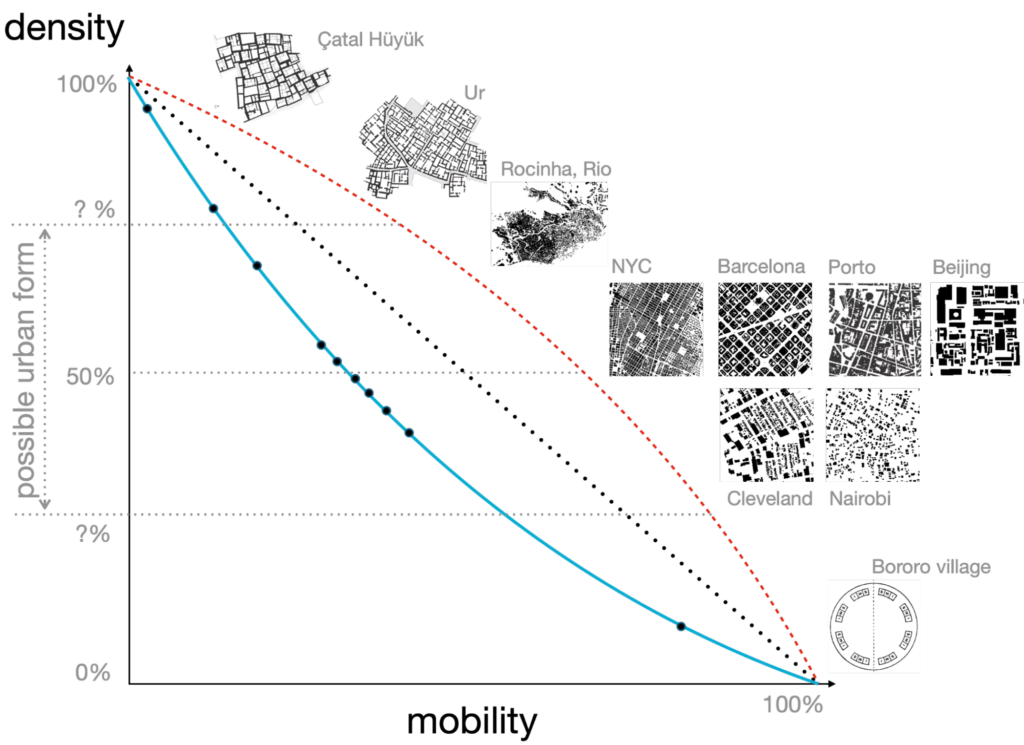
This research asks a fundamental question: why did cities emerge as the dominant spatial form for societies with increasing functional complexity, and what distinguishes them from other human settlements? Rather than focusing only on the historical evolution of particular towns or regions, the project seeks a general explanation of urban form across time and cultures. It examines cities within the wider universe of possible settlement configurations, asking why some spatial arrangements became viable for complex collective life while countless others did not. The central argument is that increasing division of labour intensifies interdependence among specialists, raising the need for interaction, proximity and concentration.
Increasing division of labour → increasing interaction.
Increasing interaction → need for proximity → density.
Density → Built form engenders physical obstructions → reduces mobility.
Reduced mobility → undermines interaction.
Spatially, this pushes settlements toward density. Yet density also creates a problem: as built form accumulates, it obstructs movement and can reduce access across the settlement. The very condition that supports interaction locally may undermine interaction at the scale of the whole system. We call this tension the density–mobility paradox.
A morphospace for urban and non-urban settlements: The cube illustrates the positions of configurations according to information, permeability and density signatures. Colours show intensities found by our method in cellular configurations of built form, from blue (low) to red (high). Dot sizes represent population sizes for all settlements derived from census data and archaeological estimations (Netto et al., 2025a).
We propose that cities succeeded because they developed configurations capable of reconciling density with permeability and structural organisation across scales. Cities are therefore not simply large or dense settlements, but specific spatial solutions to the demands of complex cooperation.
To explore this, the research introduces the concept of morphospace to urban studies. Borrowed from biology, morphospace refers to the space of possible forms or configurations. Applied to settlements, it allows us to compare the forms that are theoretically possible with those actually explored by human societies. Urban morphogenesis is understood as a trajectory through this space: not a random exploration of all possible forms, but a path-dependent, selective and materially constrained process of structure-seeking growth. Societies do not simply “bump into” cities by chance; they progressively search for forms capable of supporting intensified interaction, mobility and coordination.
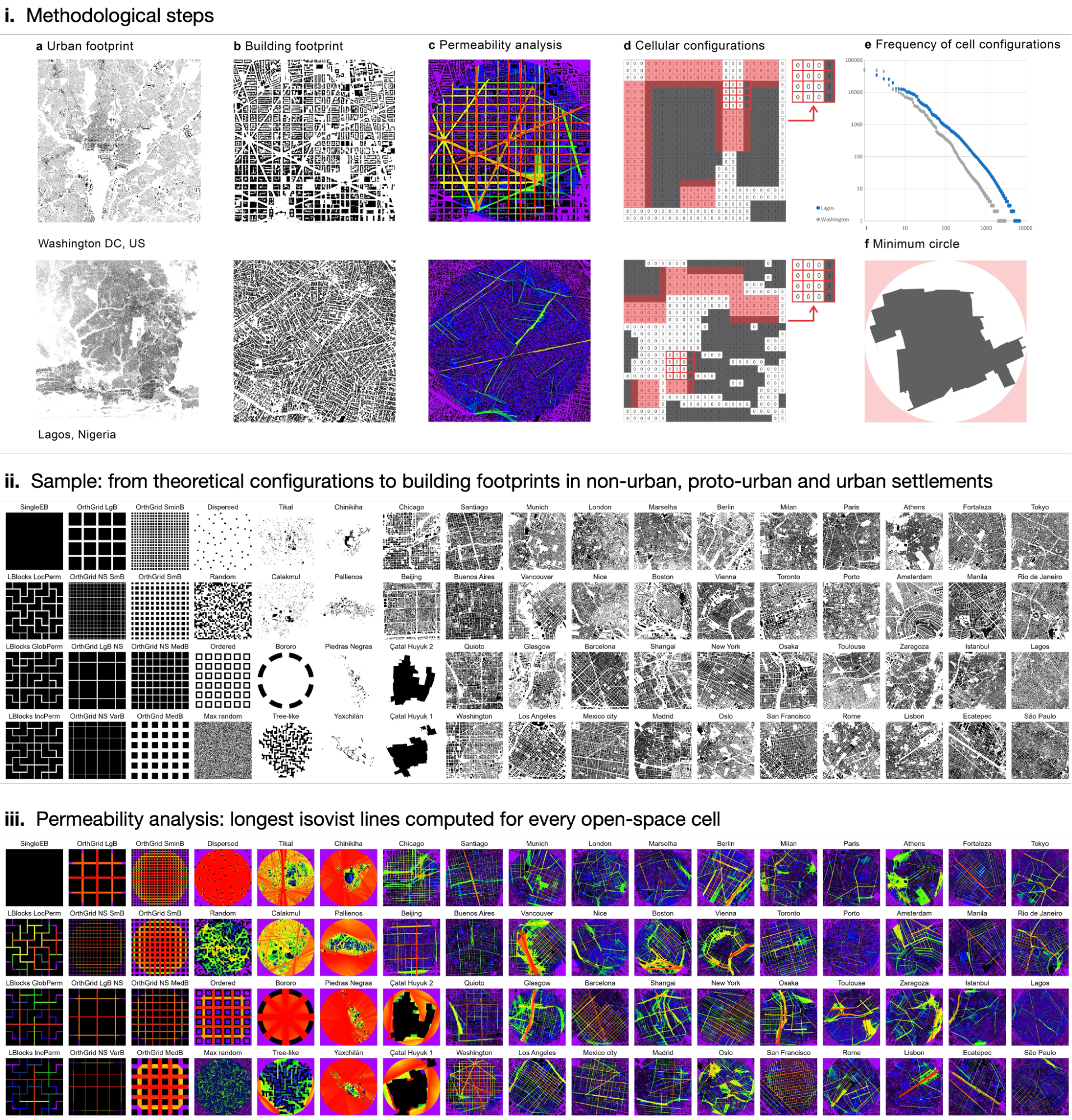
Finding signatures of information, permeability and density in human settlements and theoretical configurations: (i) Urban and building footprints are extracted and analysed for density, permeability and information. Permeability is measured through the longest visible line from each open-space cell, while information is computed from the frequency of built-form cellular combinations. For non-urban and proto-urban settlements, measurements are taken within the minimum circle enclosing all buildings. (ii) The sample includes 68 cases, from theoretical configurations to real building footprints. (iii) Longest-line analysis across open-space cells reveals the depth and shape of open space as key dimensions of permeability (Netto et al., 2025b).
Methodologically, the project identifies the morphological signatures of cities through three dimensions: density, the concentration of built form; permeability, measured through the extension, depth and continuity of open spaces in relation to building footprints; and information, understood as the degree of structural regularity, correlation and organisation in built form. These dimensions are combined into a three-dimensional morphospace model and applied to theoretical configurations, hunter-gatherer and proto-urban settlements, archaeological cases and contemporary cities. The results suggest that cities cluster within a narrow region of morphospace: neither maximally dense nor maximally ordered, but balanced enough to sustain interaction, enable movement and encode spatial organisation. In this sense, cities can be understood as a rare but reproducible solution to a deep socio-spatial problem: how to organise dense, interdependent and mobile forms of collective life. Urban form is not incidental; it is part of the material infrastructure of cooperation.
Spatial cultures: Urban form as information
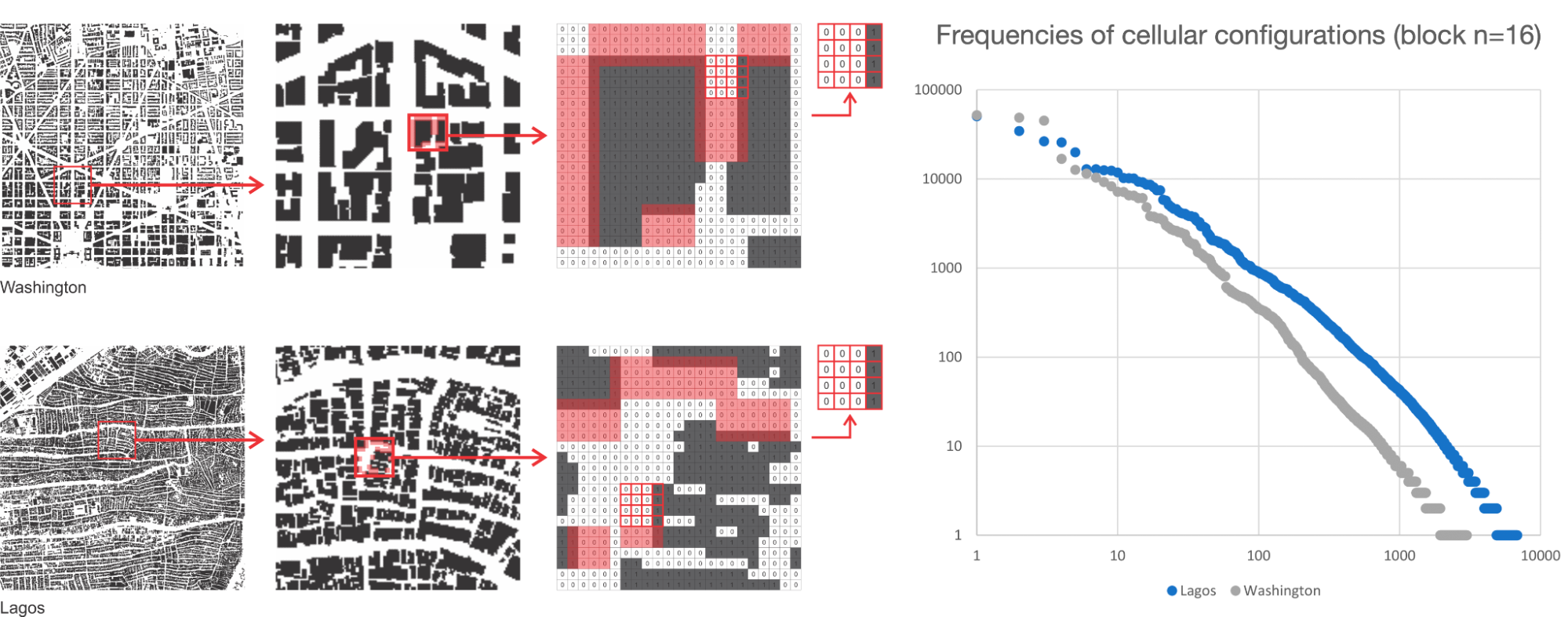
Identifying cultural information encoded in built form: Urban footprints of Washington (US) and Lagos (Nigeria). Information is computed as the algorithm scans built form maps counting frequencies of cellular configurations (n= 16), with an example in red showing where it is found. The total number of configurations n = 16 found in Washington (grey line) is 2989, and 6825 in Lagos (blue line) out of 65,534 possible combinations. Washington consistently shows regular arrangements, which contrasts with the variety in Lagos
(Netto et al. 2023).
This research asks whether cities encode cultural differences in their physical form — in the way buildings are arranged, aggregated and separated by open spaces. It explores the idea that urban space encodes informational signatures of different spatial cultures, leaving material traces of how societies organise and produce space. Rather than focusing only on street networks, the study analyses building footprints across more than 60 cities worldwide, using Shannon’s information theory to measure entropy in cellular configurations of built form. The findings suggest that cities and regions do not have a single exclusive “cultural pattern”, but tend to cluster around particular ranges of built-form entropy, reflecting different degrees of order, regularity, fragmentation and unpredictability. In this way, the project introduces a new information-based approach to urban morphology, showing that the combinatorial complexity of buildings adds a crucial dimension to understanding spatial cultures and modes of urban production.
Publications
Netto, V. M. (2017). Notes on the genesis of form. Chapter 6 In: The Social Fabric of Cities (pp. 125–152). Routledge.
Netto, V., Cacholas, C., Daems, D., Ribeiro, F., Davis, H., & Lenz, D. (2025a). Deciphering Urban Morphogenesis: A Morphospace Approach. In: Marques, B. et al. (Eds) Proceedings of the 7th International Symposium on Formal Methods in Architecture (7FMA), Porto: ESAP. Available at: https://link.springer.com/chapter/10.1007/978-3-032-02782-5_3
Netto, V., Cacholas, C., Ribeiro, F., Daems, D., Lenz, D., & Davis, H. (2025b). Trajetórias no Morfoespaço: O que distingue cidades de outras configurações? Revista de Morfologia Urbana, 13(2). https://doi.org/10.47235/rmu.v13i2.489
Netto, V. M., Lenz, D., Ribeiro, F., Daems, D., Cacholas, C., & Davis, H. (2025c). Desafios na reconstrução do surgimento das cidades: Integrando simulações computacionais e evidências arqueológicas. In D. L. Viana et al. (Eds.), Para além da forma: Território e desafios societais: Anais da 13ª Conferência PNUM 2025. Universidade Portucalense. https://doi.org/10.34625/ISBN.978-972-9354-53-3
Netto, V. M., Brigatti, E., & Cacholas, C. (2023) From urban form to information: Cellular configurations in different spatial cultures. Environment and Planning B-Urban Analytics and City Science, 50, p.239980832211073-161. https://doi.org/10.1177/23998083221107382
Brigatti, E., Netto, V. M., De Souza Filho, F. N. M., Cacholas, C. (2021) Entropy and hierarchical clustering: Characterizing the morphology of the urban fabric in different spatial cultures. Chaos, v.31, p.113138. https://doi.org/10.1063/5.0069258