
We examine how the spatial configuration of the urban fabric and the distribution of land uses co-evolve to shape patterns of accessibility, activity, and everyday behaviour. Cities are understood as systems where different functions – residential, commercial, social – must remain sufficiently proximate to enable exchange, interaction, and movement. In this sense, land use mix is not merely a compositional attribute but a fundamental condition of urbanity, closely tied to how street networks structure accessibility and how activities locate within them. Empirical work shows that configurational properties of the street network – such as centrality and integration – both influence and are reinforced by the distribution of land uses, producing feedbacks between movement potentials and the spatial allocation of economic and social functions.
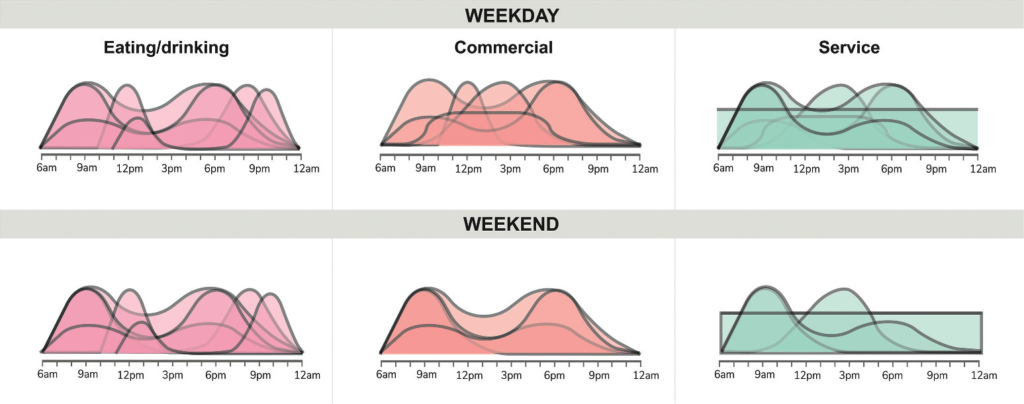
At the same time, our research highlights that the effects of land use patterns depend not only on the presence or density of non-residential activities, but on their diversity, proximity, and spatial arrangement across scales. Different measures of land use mix – such as entropy, richness, and balance between uses – capture complementary dimensions of this phenomenon, revealing that more balanced and diverse environments tend to support higher levels of activity, including utilitarian movement such as walking. Crucially, these effects are mediated by spatial configuration: accessibility conditions can both enable the emergence of mixed-use patterns and shape their behavioural outcomes. This integrated perspective moves beyond viewing land use and movement as separate domains, instead framing them as interdependent components of urban systems, where spatial form, functional diversity, and human activity are mutually constitutive.
Publications
Kretzer, G., Kanashiro, M., & Tibiriçá de Saboya, R. (2024). Complementarity between urban land uses: A temporal analysis. Journal of Urban Design, 29(4), 468–485. https://doi.org/10.1080/13574809.2023.2280272
Saboya, R. T. de, D’Orsi, E., & Keivani, R. (2024). Promoting active aging in Brazil: A longitudinal study of land use mix and utilitarian walking in older adults. Cities, 154, 105318. https://doi.org/10.1016/j.cities.2024.105318
Salvador, C. C., Lopes, A. A. D. S., Saboya, R. T. D., Kanashiro, M., & d’Orsi, E. (2024). Land use mix and walking for transportation among older adults: An approach based on different metrics of the built environment. Urbe. Revista Brasileira de Gestão Urbana, 16, e20220211. https://doi.org/10.1590/2175-3369.016.e20220211