
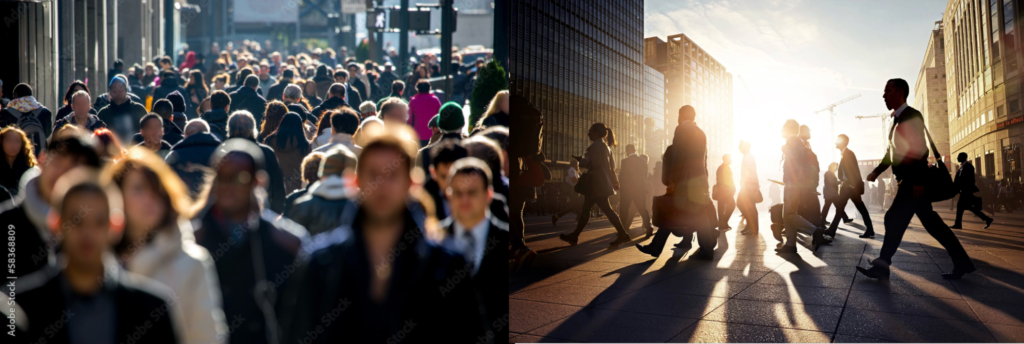
Images of urban vitality.
Does architecture matter for urban vitality? We examine whether buildings matter to urban vitality, understood as the presence of pedestrians in public space, co-presence among different users, and the diversity of local economic activity. Rather than treating architecture as a passive backdrop, the project argues that buildings have measurable social effects through the way they meet the street, relate to neighbouring buildings, and organise movement, visibility, and access. This research focuses especially on a major transformation in modern and contemporary cities in many regions of the world: the replacement of compact, continuous urban fabrics by detached high-rise buildings and gated compounds surrounded by setbacks, walls, railings, and parking lots. The research suggests that this shift has contributed to fragmented urban form and to a weakening of everyday public life. We approach this problem through a large empirical study in three Brazilian capitals: Rio de Janeiro, Florianópolis, and Porto Alegre, showing strong convergence across the three cities.
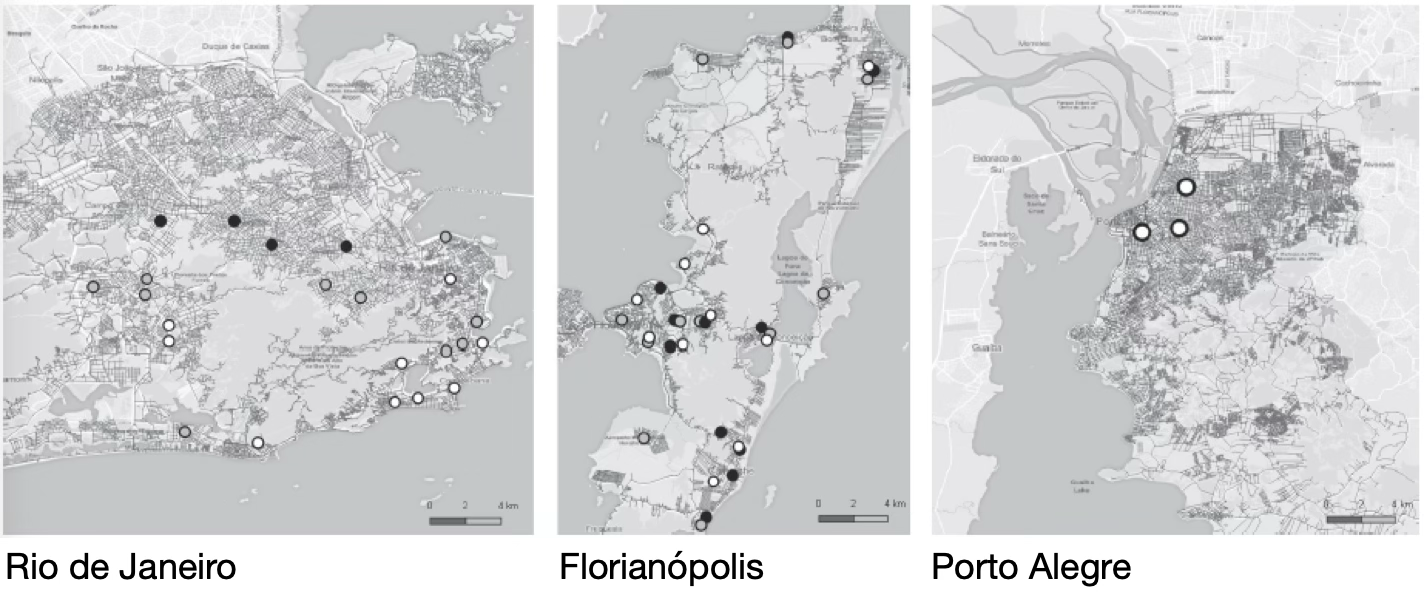
Selected areas in Rio de Janeiro, Florianópolis, and Porto Alegre (Netto et al., 2019).
A binary typology. At the core of the project is a simple but powerful distinction between two building types. The continuous type is formed by buildings that connect directly to neighbours and engage the street through continuous façades and direct interfaces. The detached type stands apart within the plot, typically separated from the street and adjacent buildings by setbacks, walls, or open areas. This distinction is used not as a stylistic classification, but as a way of capturing a fundamental relational property of built form.
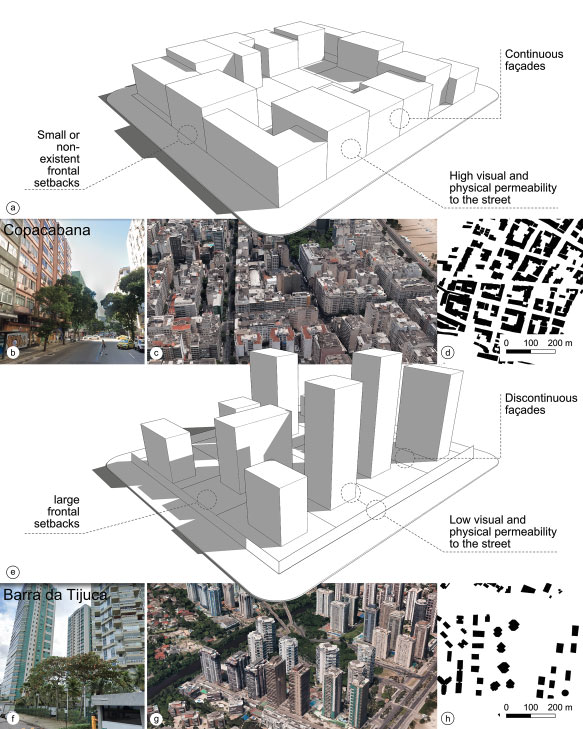
Different building types and radically different urban forms: (a) The continuous type leads to compact blocks, seen in Copacabana, South Rio: (b) Street view; (c) Aerial view; (d) Building footpring. In turn, (e) The detached type is associated with varying setbacks and other features seen in Barra da Tijuca, West Rio: (f) Street view; (g) Aerial view; (h) Building footpring. Combinations of these basic types create a plethora of built forms.
(Sources: Google Street View; Google Earth; OpenStreetMap – Netto et al., 2024).
The central hypothesis is that continuous buildings are more supportive of urban vitality. They tend to create façade continuity, higher densities of doors and windows, closer contact with sidewalks, and better conditions for street-level economic activity. Detached buildings tend to do the opposite: they increase distances, weaken the building–street interface, reduce permeability and visibility, and discourage pedestrian appropriation of public space.
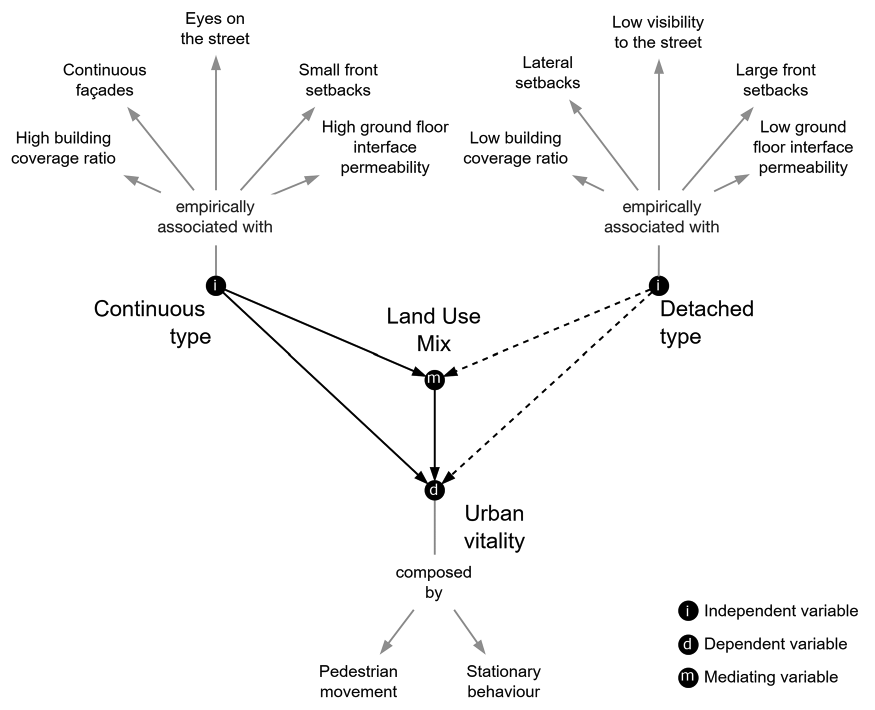
The research problem and its ontology: the empirical association of building types with specific architectural features is hypothesized at the top. Lines indicate hypothetical causal positive relationships between building type, associated features, and urban vitality, while dashed lines represent negative relationships
(Netto et al., 2024).
Methodologically, the research combines urban morphology, land-use survey, field observation, and statistical modelling. In Rio de Janeiro, the study analysed 24 randomly selected areas, 249 street segments, and 4,174 buildings, recording pedestrian movement, stationary co-presence, architectural features, densities, land uses, and street-network accessibility. The comparative study extended the analysis to 46 areas across Rio, Florianópolis, and Porto Alegre, covering hundreds of street segments and thousands of buildings. A key innovation is the effort to identify the effects of buildings while controlling for systemic urban factors such as accessibility and density.
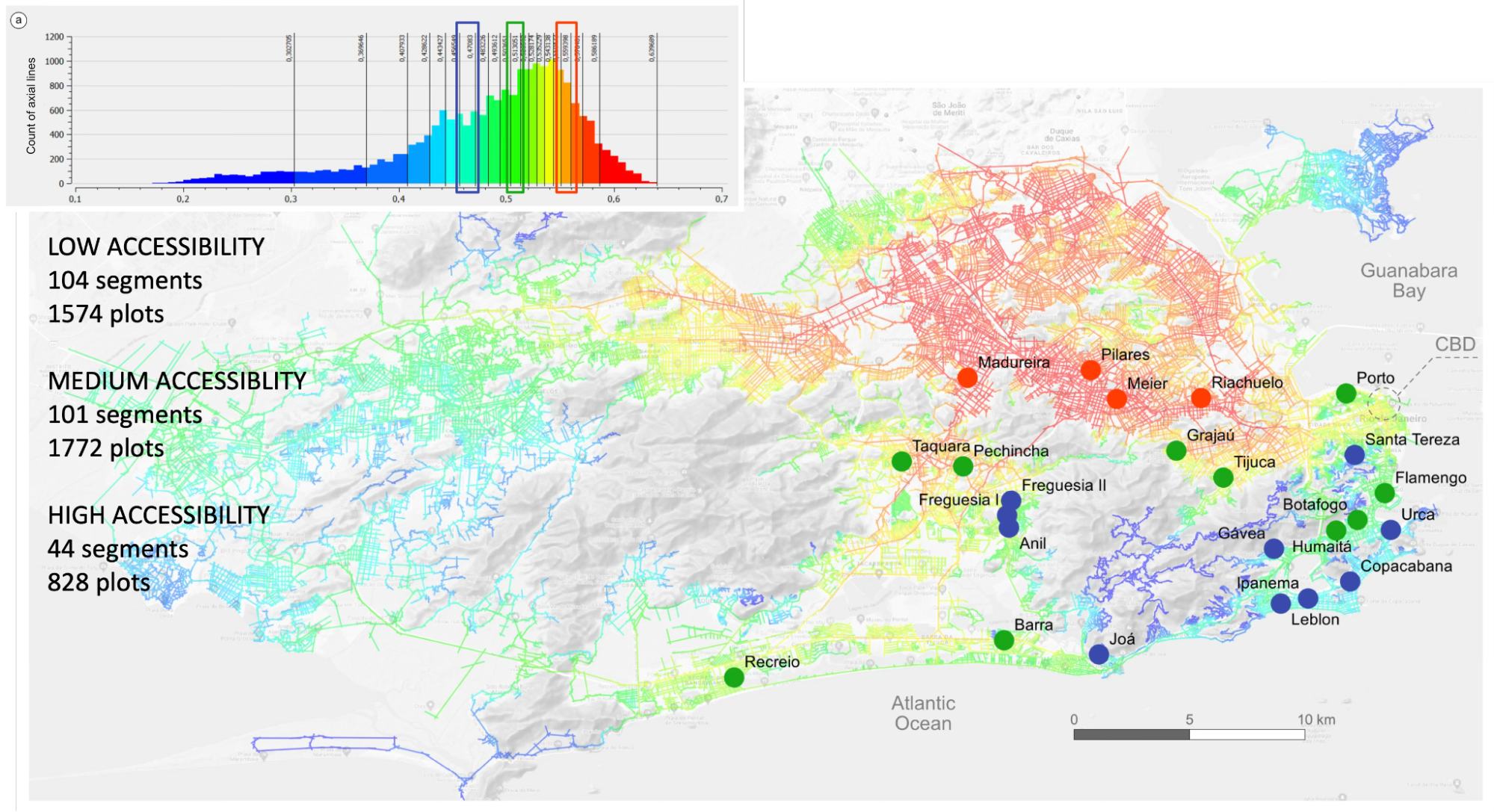
Sample construction. Histogram of the distribution of streets according to closeness centrality (CCRR) values: twenty bands were generated based on quantiles. Our method combined accessibility and density levels as criteria for randomly selecting areas to be analysed in the empirical study. Twenty-four areas were sampled in Rio de Janeiro (Netto et al., 2024).
The findings are consistent across the cases. Streets dominated by continuous buildings show substantially more moving and stationary pedestrians than streets dominated by detached buildings. Pedestrian presence rises with façade continuity, door and window density, and direct open interfaces between buildings and sidewalks; it falls with front and side setbacks, walls, and the predominance of isolated buildings. The studies also show that continuous building fabrics are more strongly associated with street-level retail, services, and greater land-use diversity, while detached fabrics are associated with weaker local microeconomic life. These results suggest that architecture matters not only aesthetically, but socially and economically. Buildings influence whether streets become lively or empty, socially appropriated or avoided, and whether local activities can emerge and thrive. The project aims to contribute to urban design and planning by showing that architectural choices accumulate into broader urban consequences. In this sense, the form of buildings is part of the infrastructure of urban vitality and, more broadly, of the material conditions that support social sustainability.
Selected for the 50th anniversary issue of Built Environment.
Originally published in 2022, this article was selected in 2024 for the commemorative 50-year edition of Built Environment, a long-established British journal in urban studies. The issue selected two articles from each of seven thematic sections, chosen from hundreds of papers published over five decades. This article appears in the section “Framing and Enabling Vital Streets,” alongside Jan Gehl’s “The residential street environment” (1980). Editor Stephen Marshall describes the article as representative of the “kind of contemporary, systematic, scientific, scholarly, evidence-based paper that we like to encourage these days”, highlighting its capacity for “asking big questions.”
Publications
Netto, V.M., Saboya, R.T., Vargas, J.C. (2024) Does Architecture Matter to Urban Vitality? Buildings and the Social Life of Streets and Neighbourhoods. Paper selected for Built Environment 50th Anniversary edition, v.50, p.448 – 471. https://doi.org/10.2148/benv.50.3.433
Netto, V.M., Saboya, R.T., Vargas, J.C. (2022) Does Architecture Matter to Urban Vitality? Buildings and the Social Life of Streets and Neighbourhoods. Built Environment, 48, 317–340. https://doi.org/10.2148/benv.48.3.317
Netto, V.M., Vargas, J.C., Saboya, R.T. (2019) The social effects of architecture: built form and social sustainability. In M. R. Shirazi and R. Keivani (Eds.) Urban Social Sustainability: Theory, Policy and Practice. London: Routledge, pp. 125–148. https://bit.ly/3AH2I5u
Saboya, R.; Netto, V.M.; Vargas, J.C. (2015) Fatores morfológicos da vitalidade urbana: uma investigação sobre o tipo arquitetônico e seus efeitos. Arquitextos 180 (2015): 1. https://vitruvius.com.br/revistas/read/arquitextos/15.180/5554
Netto, V.M.; Vargas, J.C.; Saboya, R.T. (2012) “(Buscando) Os efeitos sociais da morfologia arquitetônica” Urbe – Revista Brasileira de Gestão Urbana, 4, 2, pp. 261–282. https://doi.org/10.7213/urbe.7400