
Cities emerged independently in different regions of the world and across distinct historical periods. This raises fundamental questions: how did the first urban settlements develop? Are such processes universal, or context-dependent? What distinguishes cities from other forms of human settlement? AIM2 was developed to analyse urban spatial distributions represented through Nolli maps, understood here as binary images distinguishing built form from open space. The model measures and compares three key properties of settlement form: information, permeability, and density.
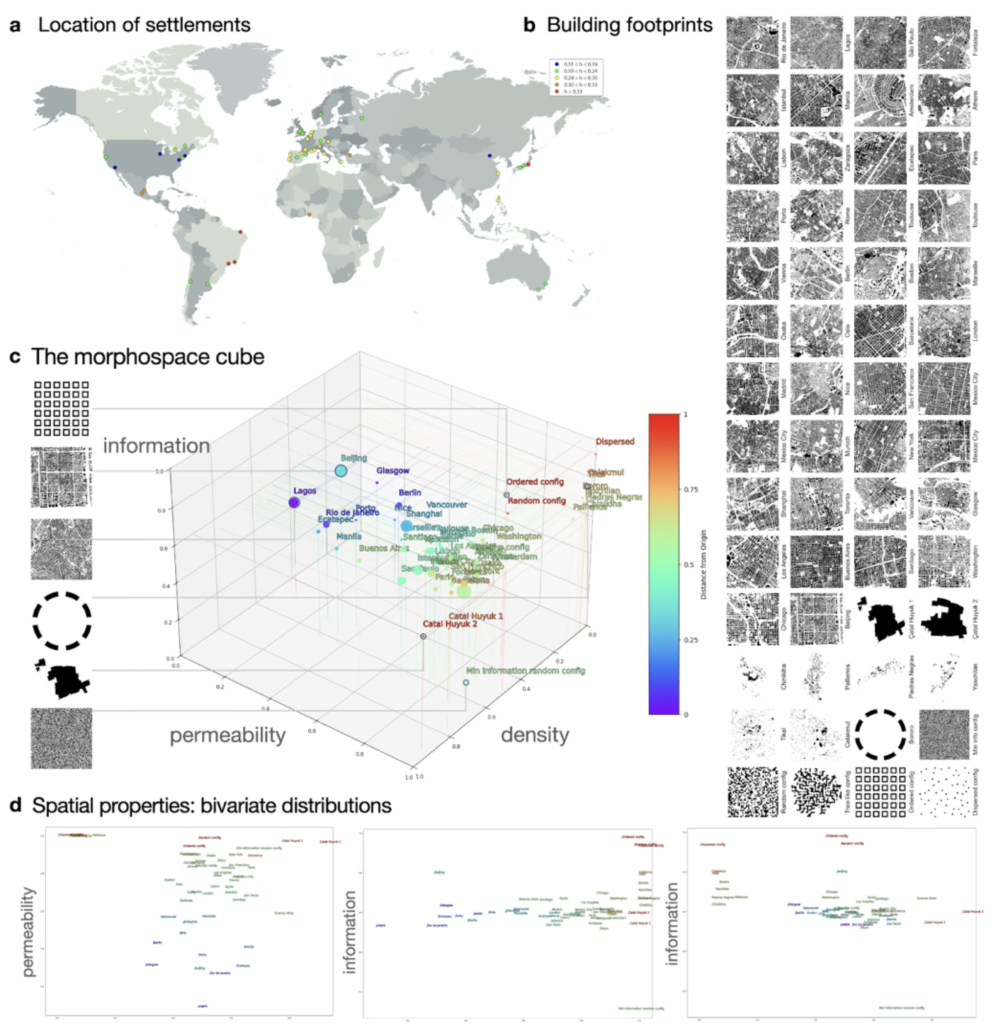
Spatial properties — information, permeability, and density — applied to morphospace: a. The location of real settlements in the sample. Colours indicate the amount of information identified by the method in cellular configurations of built form, ranging from blue — low information — to red — high information. b. Distributions of building footprints. The model compares building footprint distributions in urban and non-urban settlements. c. The morphospace illustrates the position of each configuration according to information, permeability, and density. Colours ranging from purple to red indicate intensity. Point sizes represent population size, based on census data and anthropological or archaeological estimates. d. Bivariate distributions of spatial properties. The proposed morphospace effectively distinguishes between theoretical spatial configurations, non-urban and proto-urban settlements, and contemporary cities.
We propose information, permeability, and density as characteristic properties of settlement form, capable of representing and differentiating types of settlements. AIM2 offers a morphospace: a representational space of possible configurations, in which these properties operate as analytical dimensions. The model has been applied to contemporary cities, proto-urban settlements, hunter-gatherer settlements, and theoretical configurations, and it is designed to examine the proposition that cities emerge and evolve as spatial solutions that balance density, permeability, and informational organisation, allowing them to support increasingly complex social functions (Netto et al., 2024).
Model:
https://github.com/PlanningSupportSystems/AIMM