
CUE is an interdisciplinary model developed at the intersection of urban studies, statistical physics, and computational science. It uses agent-based modelling — ABM — to investigate how different urban environments influence navigation, activity-seeking behaviour, interaction, information exchange, and social cooperation. The model represents both physical and semantic environmental information as active components in agents’ choices of paths and activities. These spatial structures affect navigation and access, with consequences for the fluidity of interaction and the emergence of cooperation.
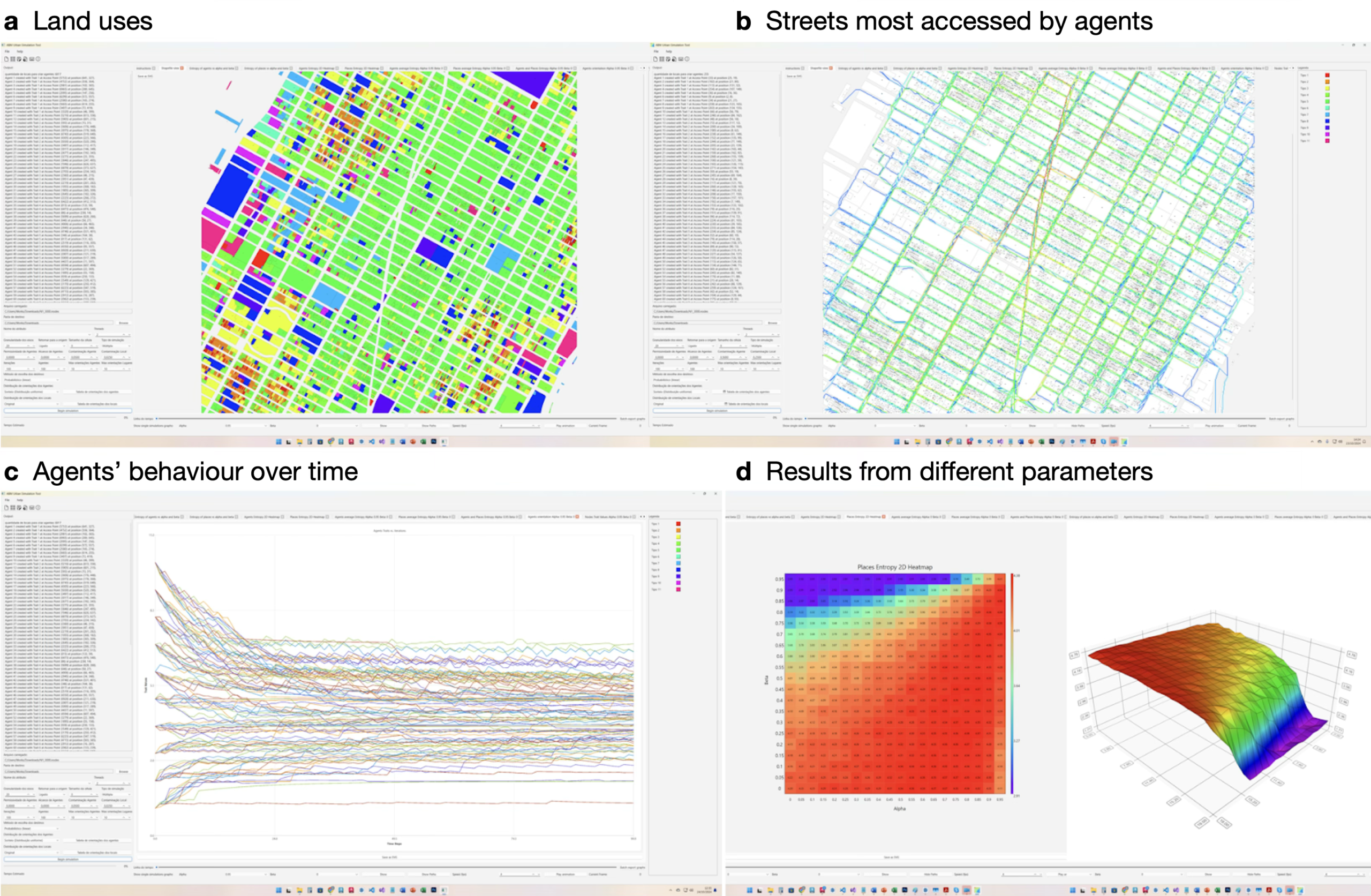
CUE simulations applied to Manhattan, New York City. Preliminary results show emerging behavioural patterns. In the simulation outputs, each coloured cell represents the degree of social entropy resulting from a specific set of behavioural parameters, distributed along the x and y axes, for a total of 400 simulations.
(Netto, Cacholas and Ribeiro; ongoing work).
The model is able to represent each agent’s behaviour through coloured trajectories that change over time as agents access places — buildings and plots — interact within them, change their behaviour, and then search for new activities. CUE analyses social entropy, an indicator of convergence among types of action and a proxy for forms of social cooperation. The model has been under development since 2017, drawing on work by Netto et al. from 2017, 2018, 2020, and 2023. The relative convergence of behavioural trajectories indicates both signs of cooperation and differences among types of action. CUE is based on two main assumptions:
a. Land uses as semantic information
Activities and land uses provide information that guides agents’ decisions about where to go and what to do.
b. Navigation structures
Agents move through the urban environment according to path-selection rules, allowing the model to simulate how spatial configuration distributes movement.
CUE aims to contribute to the study of cities as environments that organise information, enable encounters, and shape the conditions for cooperation. It provides a computational framework for exploring how urban structure can affect the emergence, intensity, and diversity of social behaviours.
Model:
https://github.com/PlanningSupportSystems/Cooperation_in_Urban_Environments