
The research behind the article selected for the 50th anniversary issue of Built Environment generated empirical data robust enough to support the development of a probabilistic computational model of architectural effects. The underlying premise is that distributions of different building types — for example, buildings positioned at the centre of plots versus buildings arranged in continuous frontages and compact blocks — are significantly correlated with the spatial distribution of residential and commercial activities in neighbourhoods, as well as with patterns of pedestrian movement along streets.
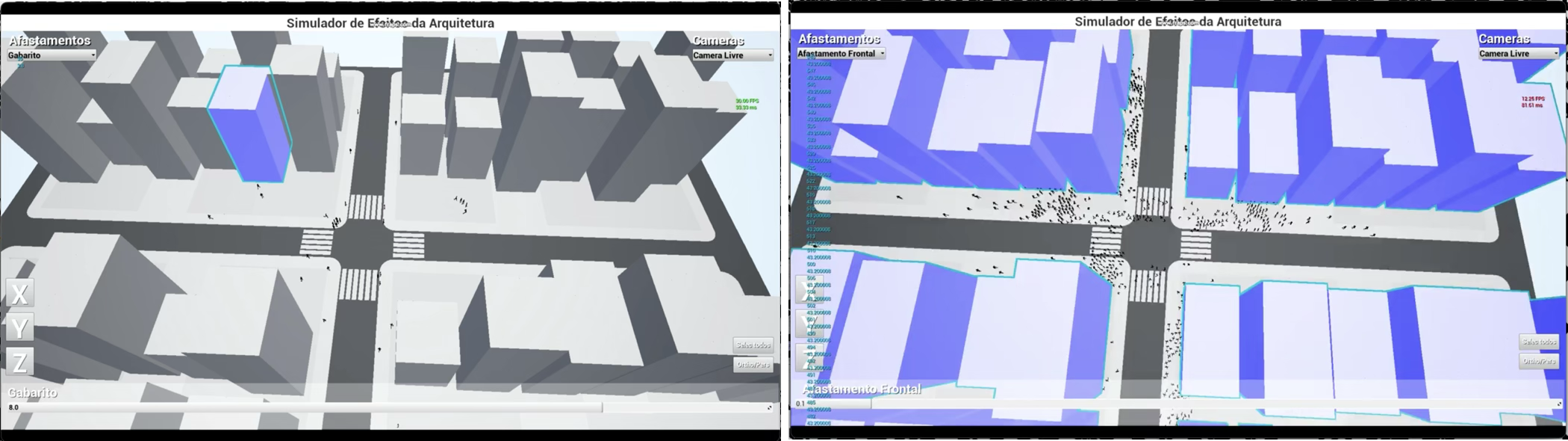
Simulator of building effects on pedestrian presence as a proxy for urban vitality
(Cacholas, Netto, Saboya and Vargas; ongoing work).
When these correlations are based on sufficiently large samples, they can be used in a predictive statistical model. SEA uses empirical data as probability distributions: given certain morphological conditions, such as the distribution of building types, and observed levels of accessibility, the model estimates whether the probability of particular intensities of pedestrian presence and commercial activity tends to increase or decrease. These probabilities should be understood as tendencies rather than deterministic predictions. Cities are not predictable in the way computers are; they contain regularities, patterns, randomness, and non-linear relations. SEA is therefore designed to simulate probable architectural effects on urban vitality, while remaining open to variation and uncertainty in the relation between urban space and social life.
The tool integrates Unreal Engine and Esri’s CityEngine plugin to create a dynamic simulation environment for urban design analysis.
Main features
Generation of urban scenarios
The tool uses CGA — Computer Generated Architecture — rules to create and model plots, buildings, streets, and other urban structures. This allows users to simulate a wide range of urban combinations and design scenarios.
Simulation of pedestrian movement dynamics
Drawing on relationships identified in empirical research, the model simulates pedestrian volumes and movement behaviour within urban environments. This enables the study of how architectural form may influence movement patterns.
Probabilistic analysis of urban vitality
The simulation assesses how different architectural configurations tend to affect the vitality of urban environments, using pedestrian presence and commercial activity as key indicators.
By combining empirical research and simulation, SEA offers a tool for architects, planners, educators, and researchers interested in visualising and analysing how design decisions may shape the social vibrancy of urban spaces.
Model:
https://github.com/PlanningSupportSystems/Simulador_de_efeitos_da_Arquitetura