
Our research investigates how urban morphology affects pedestrian navigation and spatial orientation in urban environments. The study is grounded in the idea that navigation is not only a matter of moving from one point to another, but also a cognitive and perceptual process shaped by route choices, visual references, spatial memory, decision points, and the legibility of the built environment. In the experimental stage, participants navigate these immersive urban environments while performing orientation and route-choice tasks. Their trajectories and navigation performance are recorded and compared with the spatial properties of each scenario. By relating measurable characteristics of urban form to human behavior in VR, the research examines how different scales of morphology influence the ways people perceive, decide, move, and construct spatial understanding during urban navigation.
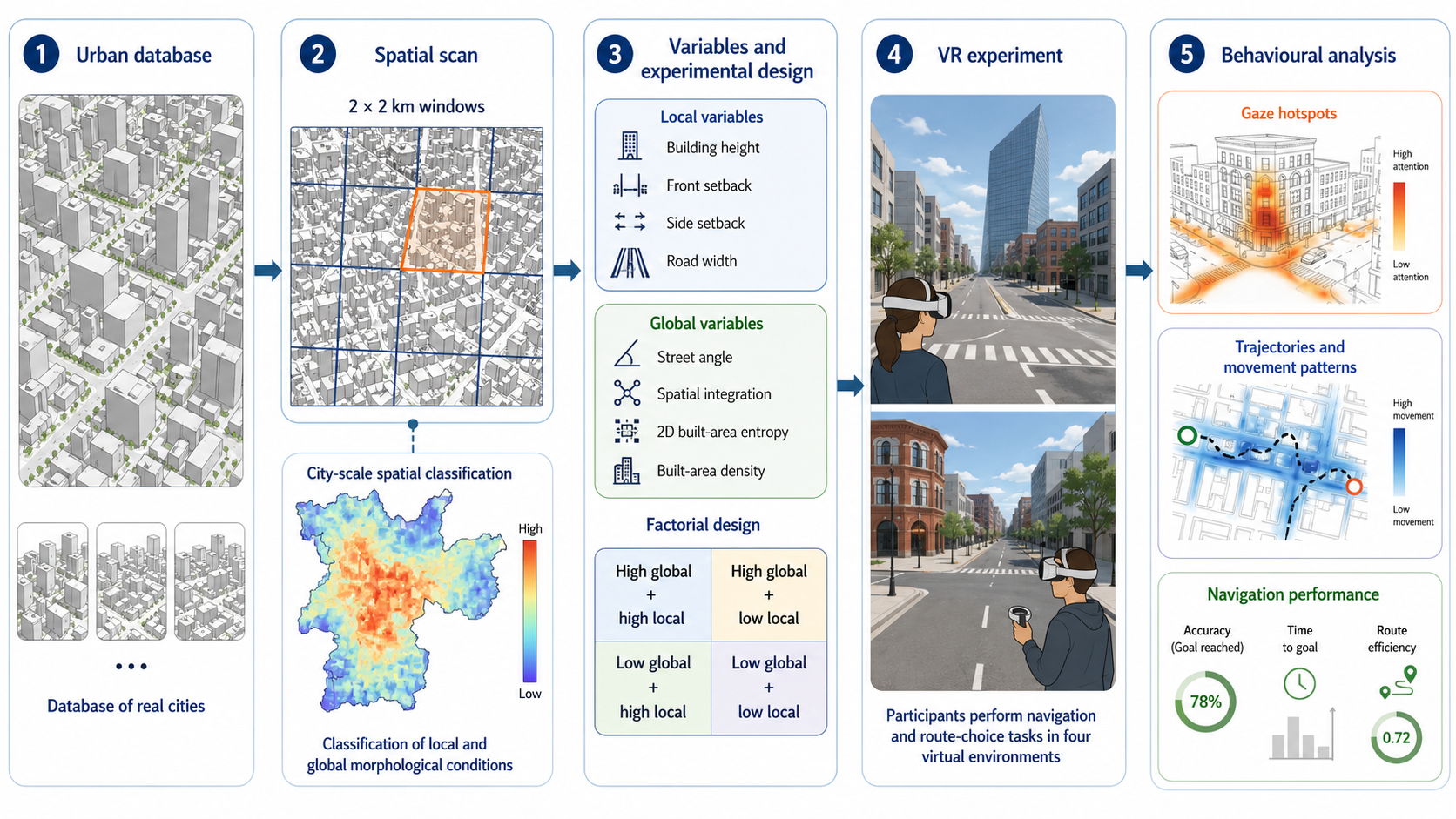
From urban form to spatial behaviour: A multi-scalar research design linking real-city morphologies to immersive VR experiments, where participants navigate controlled urban scenarios. By combining spatial metrics (local and global), behavioural tracking (gaze, trajectories), and performance measures, the framework reveals how variations in urban morphology shape perception, decision-making, and navigation in the built environment.
of urban vitality.
We also investigate the relationship between the urban environment and well-being, focusing on how the physical characteristics of streets influence the perception, affective response, and stress levels of the population. The study seeks to understand, therefore, how urban design can contribute not only to the functionality of cities but also to the quality of life of their inhabitants. The methodology used consists of the visual analysis of urban scenarios with controlled variables, such as the presence of natural elements, verticalization, vehicular mobility, and physical barriers. Participants answer an online survey in which they evaluate manipulated images of streets based on attributes such as pleasantness, beauty, safety, and potential for psychological restoration. The results aim to contribute to the theoretical and practical advancement of urban planning.