
We investigate the relationship between urban heat island mitigation strategies and urban morphology. As heat islands become more intense and frequent under climate change, it is increasingly important to understand how urban planning can help reduce their effects. The study reviews mitigation strategies identified in the literature and examines how their performance varies according to the morphological characteristics of the urban fabric. Its central aim is to understand how different strategies behave across distinct urban configurations. Using ENVI-met microclimatic simulations, the research evaluates the performance of these interventions in different urban scenarios, exploring how urban form influences the effectiveness of heat island mitigation strategies.
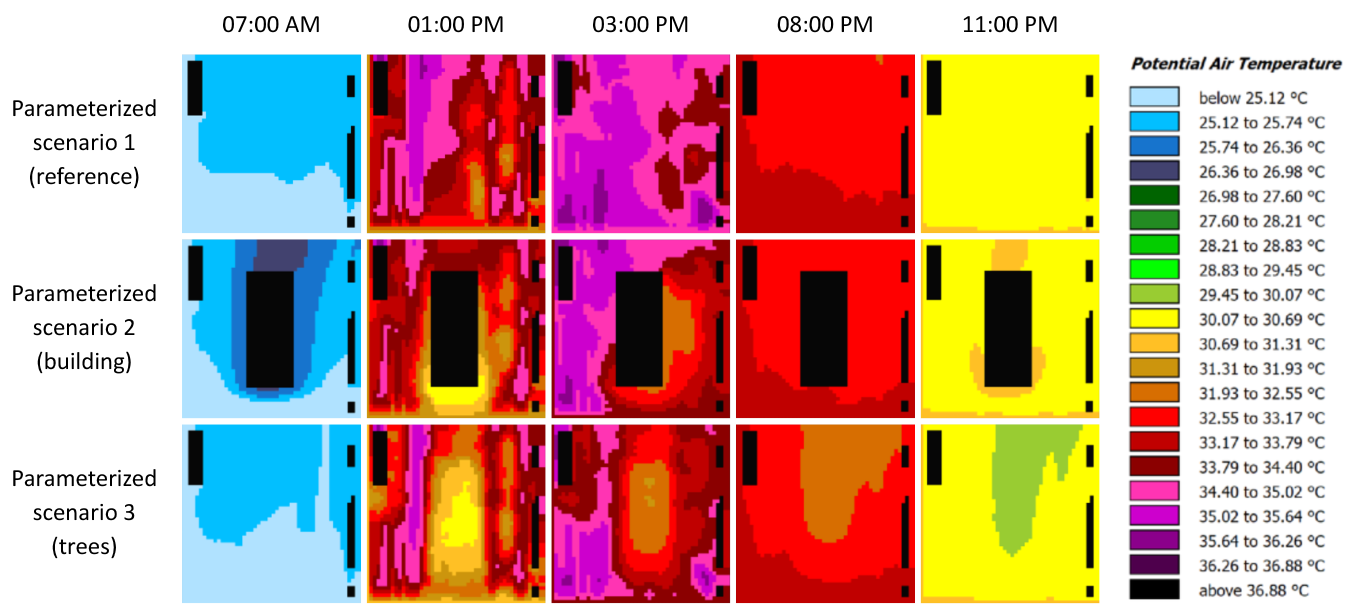
ENVI-met microclimatic simulation of three urban scenarios in Niterói: (1) the current site condition, with partially impermeable ground and sparse vegetation; (2) the implemented development scenario, with a 19-storey building, ground floor, parking levels and rooftop occupying most of the plot; and (3) a hypothetical green-park scenario, with extensive tree cover. Simulations were anchored to the extreme heat conditions of 18 March 2022, when Niterói reached 38.6°C. Results show that the vegetated scenario reduces potential air temperature at several times, especially at night, while the dense built scenario increases night-time temperatures due to greater heat retention by built and impermeable surfaces.