
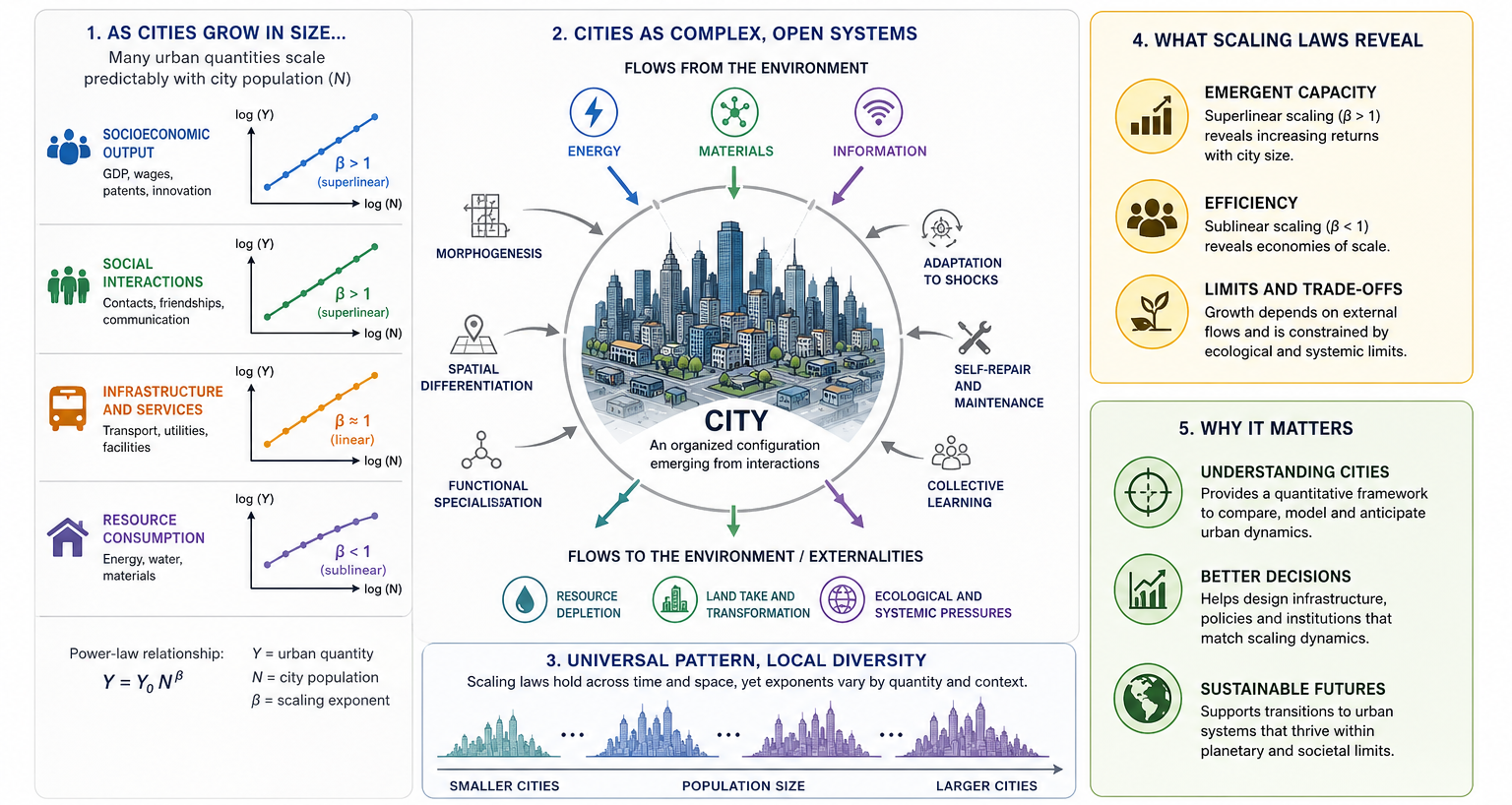
Urban scaling laws: as cities grow in population size, different urban quantities change at different rates. Socioeconomic outputs and interactions often grow superlinearly, infrastructures and spatial structures tend to scale sublinearly, and individual needs tend to scale more linearly. The figure represents cities as complex, open systems in which population size, interaction density, spatial organisation, infrastructure, resource flows and contextual limits shape urban performance across scales.
Our research, led by urban scaling expert Fabiano Ribeiro, investigates the complex evolution of cities as they grow, moving beyond the notion that larger cities are merely scaled-up versions of smaller ones. We explore urban scaling theory, complexity science, spatial economics, and urban morphology to explore the relationship between population size and various factors, including socioeconomic outputs, infrastructure needs, individual requirements, interaction opportunities, and environmental pressures.
A core focus is the non-linear behaviour of cities. While growth can lead to increasing returns in innovation, economic activity, and intensified interaction, it also presents trade-offs such as congestion, inequality, increased resource demand, and systemic vulnerability.
Furthermore, we examine the boundaries of universal scaling laws, investigating how specific elements – like urban form, street networks, density, accessibility, spatial cultures, and city boundaries – can either shape or disrupt these scaling effects. Through this lens, urban scaling serves as a method for understanding both the underlying regularities and the rich diversity present in cities as complex sociospatial systems.
Publications
Meirelles, J., Ribeiro, F. L., Cury, G., Binder, C. R., & Netto, V. M. (2021). More from Less? Environmental Rebound Effects of City Size. Sustainability, 13(7), 4028. https://doi.org/10.3390/su13074028
Ribeiro, F. L., Meirelles, J., Netto, V. M., Neto, C. R., & Baronchelli, A. (2020). On the relation between transversal and longitudinal scaling in cities. PloS one, 15(5), e0233003. https://doi.org/10.1371/journal.pone.0233003
Ribeiro, F.L., Netto, V.M. (2025). Urban Scaling Laws. In: Rybski, D. (eds) Compendium of Urban Complexity. Understanding Complex Systems. Springer, Cham. https://doi.org/10.1007/978-3-031-82666-5_2