
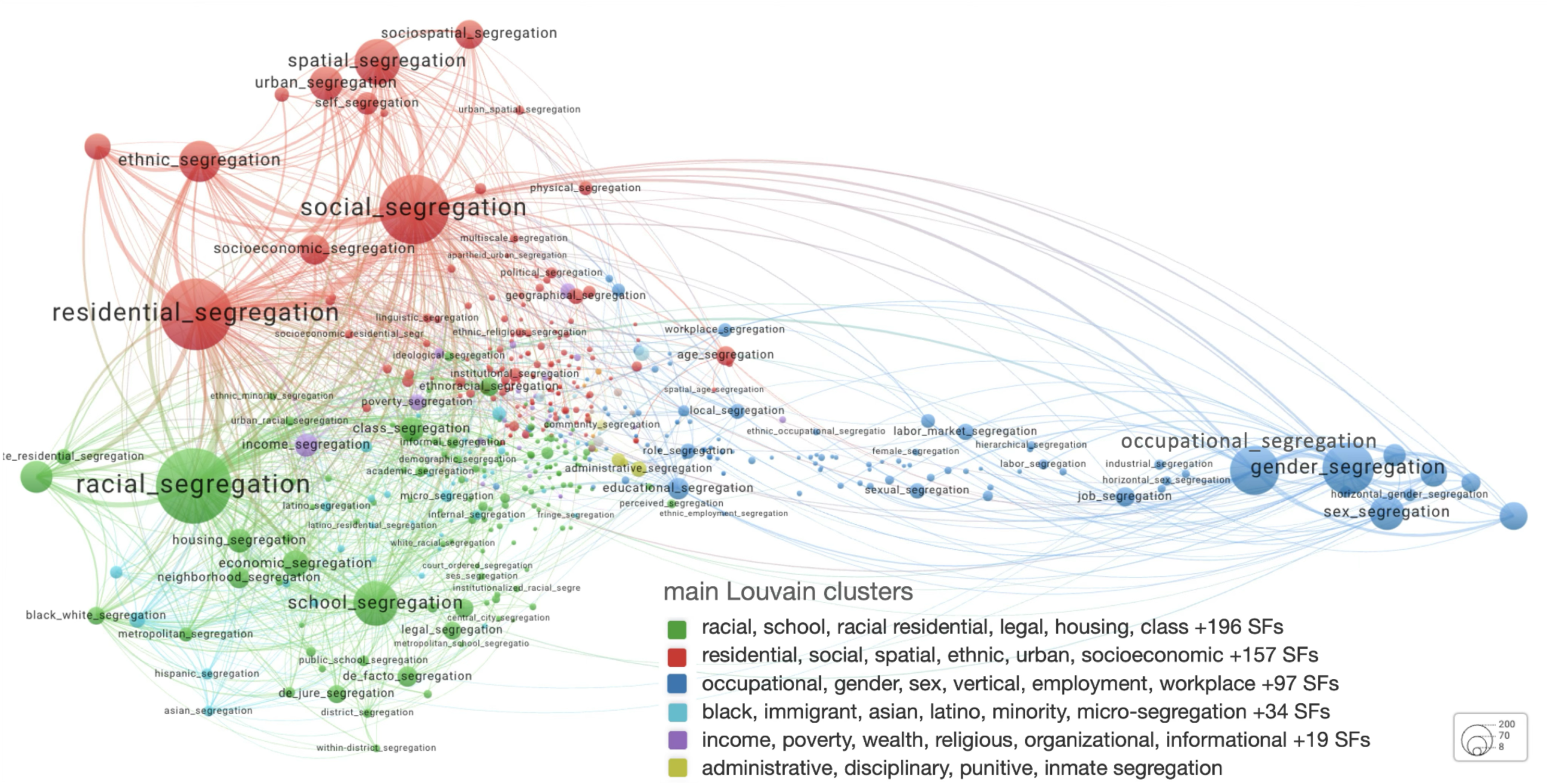
The study identified 804 segregation forms across more than a century of research and 169 disciplinary fields, showing both the exponential growth of the field and its strong conceptual interconnections.
Navigate the interactive network for more detail.
We introduced a bottom-up ontology of segregation that maps how different forms of segregation relate to one another across the research literature. Rather than imposing predefined categories, this work identifies segregation forms as discourse-level units in research and groups them into higher-order segregation dimensions through semantic clustering, network analysis, and expert interpretation. It reconstructs the field from the forms that researchers themselves have identified over time, revealing their semantic connections, overlaps, and conceptual pathways. The result is a relational landscape of segregation forms that helps researchers navigate conceptual overlaps, multidimensional intersections, and underexplored areas in an otherwise fragmented field.
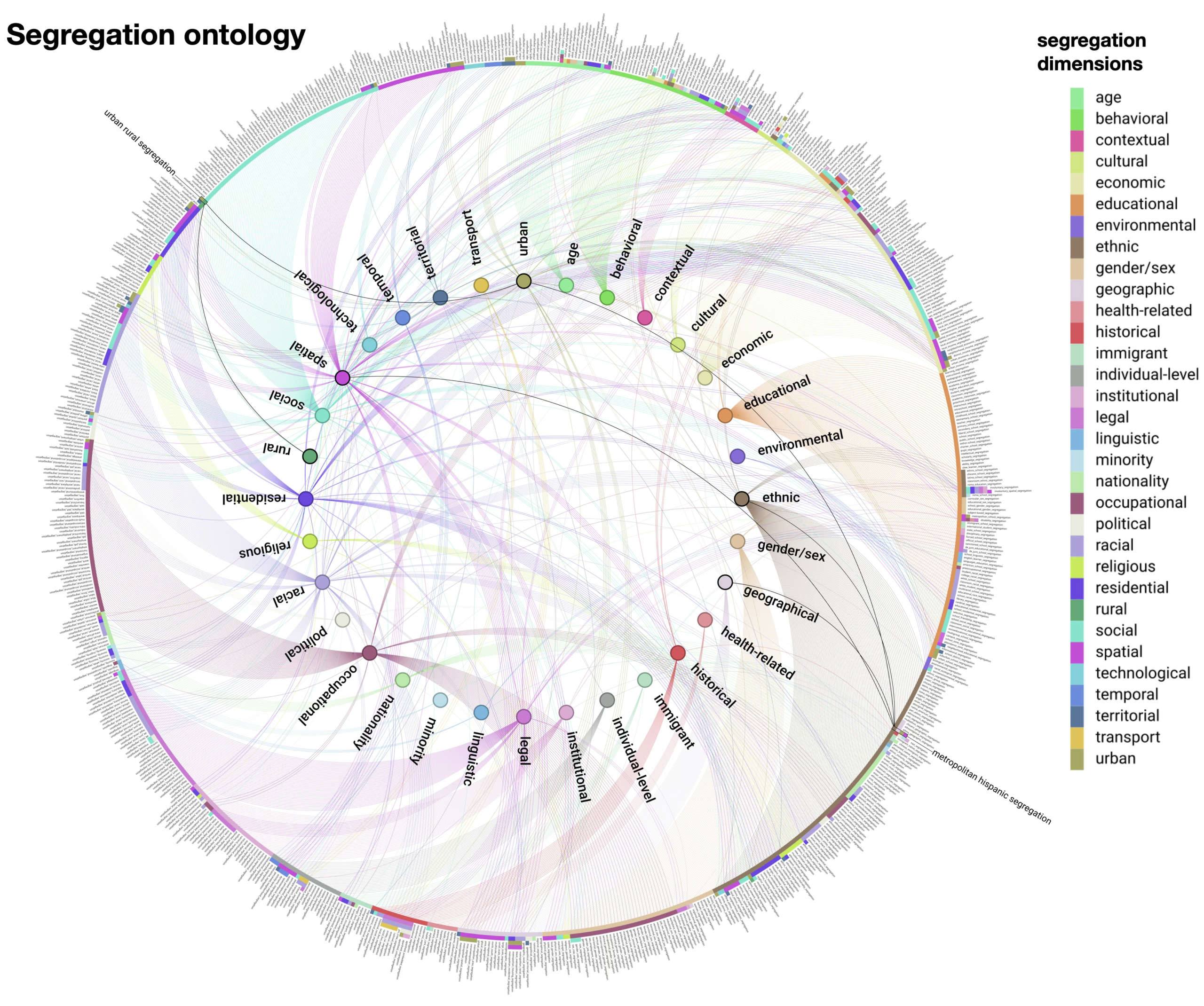
Network ontology: the inner ring contains 32 semantic dimensions, the outer ring contains 804 identified SFs. Colors represent dimensions. The lines connect each dimension with all the SFs that they are associated with. Colored dots in the SF ring show the dimensions associated with each SF. Two randomly selected examples illustrate how SFs may span multiple dimensions. Explore the interactive ontology for more detail.
Publication
Netto, V., Krenz, K., Fiszon, M. F., et al. (2025). Decoding segregation: The topological landscape of segregation forms and a bottom-up ontology (Version 1) [Preprint]. Research Square. https://doi.org/10.21203/rs.3.rs-6246485/v1